SEO Content Strategy: A Practical Page Plan
Build an SEO content strategy that connects demand, existing URLs, useful pages and business goals. Includes a worked Meridian example and a planning worksheet.
Updated
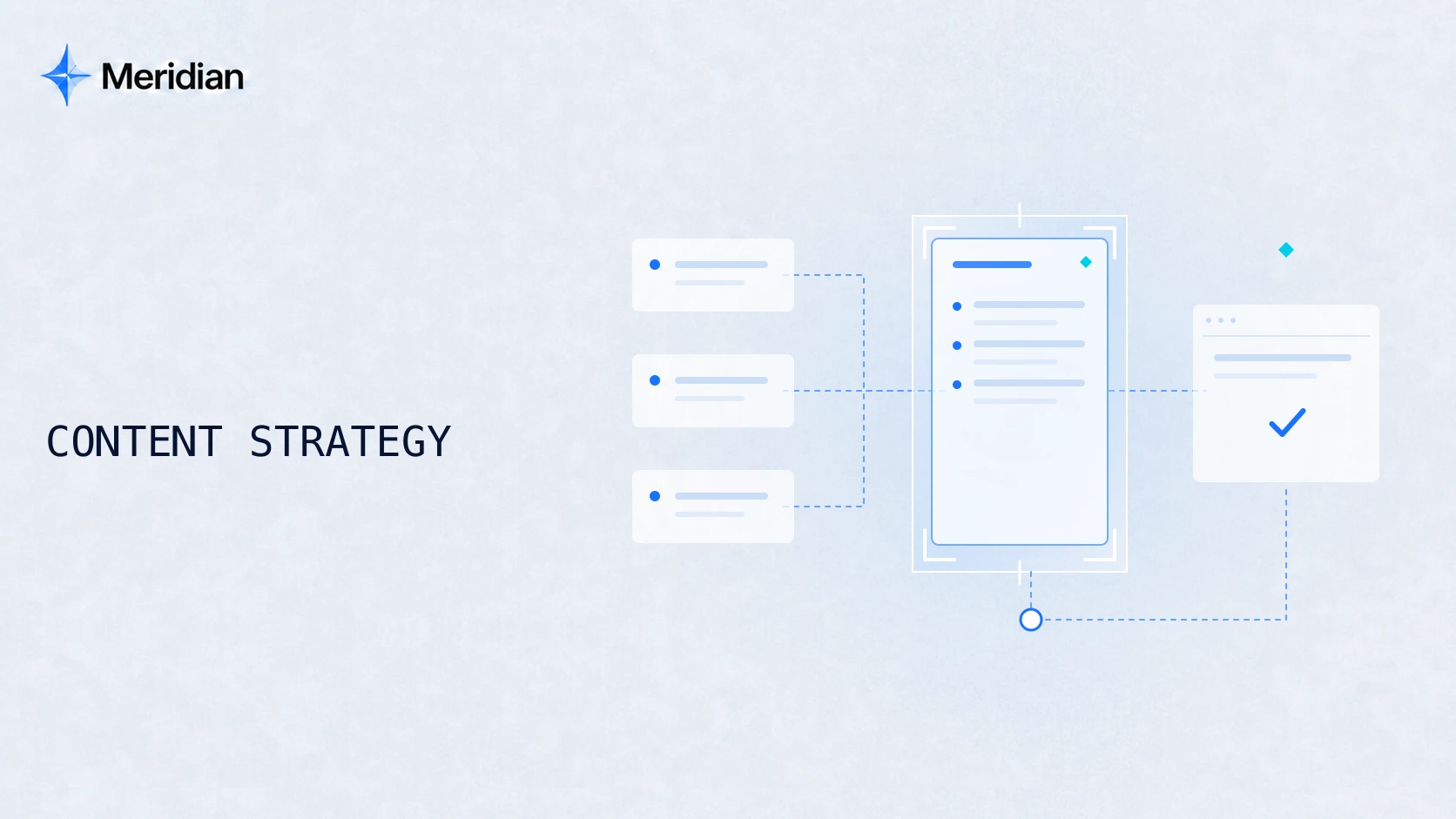
An SEO content strategy decides which search needs your business can answer, which pages should answer them, what evidence those pages need and how readers can take a useful next step. Its output is a prioritized page plan with owners and acceptance criteria, followed by production and review.
Use the process below to turn a keyword list into a working queue. The worked example uses Meridian's own SEO audit content; the AI and SaaS product examples are explicitly illustrative.
Start with the business event and the reader
For a self-serve AI tool, distinguish registration, first successful use and trial-to-paid conversion. For enterprise SaaS, distinguish a Demo request, an attended Demo, a qualified lead and a sales opportunity. Pick the outcome relevant to the page and confirm whether you can measure it.
Then describe the reader's job. A sales manager looking for meeting notes may need a reusable template; a security buyer evaluating a knowledge base may need permission details and an implementation explanation. Those readers require different evidence, even if both products use AI.
Write a simple planning statement: “Help [reader] complete [task], using [real capability or evidence], with [appropriate next step].” Keep the goal specific enough to judge a proposed page.
Group queries by the task they represent
Collect language from customer questions, sales conversations, support requests and relevant search queries. Keyword tools help estimate demand; Search Console shows queries and pages your own site has appeared for. Record the tool, market, date and exact expression rather than copying an unexplained volume column.
Inspect the search results for the main query and meaningful variations. Are searchers being offered a service, a comparison, a tutorial, a template or a working tool? Similar words can represent different jobs. A content brief template and a content brief generator both mention briefs, but the second may require an actual tool.
Group terms when one page can satisfy the same task. Keep distinct metric observations for close variants and avoid adding their volumes together as if they were different buyers. Low difficulty estimates do not establish relevance, product fit or likely conversions.
Audit existing pages before choosing new URLs
Inventory current URLs with their primary task, actual answer, available search observations, conversion path and factual gaps. Review the content itself. A title mentioning a topic does not prove that the page resolves the question.
| Decision | When it is useful | What to record |
|---|---|---|
| Keep and maintain | The task is answered and the page is current | Facts to monitor and the next review trigger |
| Update | The right URL exists but the answer or next step is incomplete | Missing sections, evidence, examples or internal links |
| Consolidate | Multiple pages compete to perform substantially the same job | Preferred destination, unique material to retain and a reviewed redirect plan |
| Create | A distinct task lacks a useful destination | Search evidence, required capability and a specific Brief |
| Defer | Demand, capability, evidence or implementation is missing | The missing input and the condition for restarting |
Do not remove or redirect pages simply because they have low recent traffic. Check their business role, links, seasonality and unique value. A comparison page or case study can support decisions even when it is not a major search landing page.
For related questions in AI search, see our query fan-out and content planning example. It shows how several buying questions can share one page, when a different decision needs a different page, and how to distinguish editorial question mapping from a platform's actual retrieval queries.
Work through one real Meridian query cluster
This is a record of Meridian's own content planning, not a client growth case. The figures below are Semrush US estimates collected on September 14, 2026 for the September report. They have not been refreshed for this article and do not describe actual visits or buyers.
| Exact query | Estimated monthly volume | KD | Search task | Primary destination |
|---|---|---|---|---|
| seo audit cost | 1,000 | 22 | Budget for an audit | /blog/seo-audit-cost |
| seo audit pricing | 720 | 19 | Compare the scope behind the price | Same cost guide |
| how much does an seo audit cost | 390 | 17 | Understand the likely budget inputs | Same cost guide |
The related phrases support one cost guide. A separate article for each would repeat the answer. The technical audit service page performs a different task: explaining Meridian's own scope, example findings and collaboration.
The cost guide's Brief therefore requires dated supplier price examples, a scope comparison, a clearly labelled budget calculation, a quote worksheet and a next step to discuss the audit. Its public own-site audit record supports the explanation of a usable finding. It does not prove increased rankings or revenue.
The original candidate URL was /blog/technical-seo-audit-cost; the published page became SEO audit cost. The plan was updated to keep the published destination, rather than opening a duplicate old candidate. This cluster demonstrates a traceable decision and completed content. A resulting increase in inquiries has not been established.
Choose product page types only when the product supports them
The previous example is an agency acquiring clients. The table below describes pages a SaaS client might build to acquire product users. These are separate keyword libraries and illustrative queries; no search volume or customer result is claimed for them here.
| Page type | Illustrative query | What the page must let the reader do |
|---|---|---|
| Feature | AI meeting transcription | See a real input/output example and supported limits, then try or evaluate it |
| Use case | meeting notes for sales teams | Understand the actual team workflow and appropriate next action |
| Alternative or comparison | Otter alternatives | Compare dated, checked capabilities and suitability |
| Integration | meeting tool + HubSpot integration | Confirm a working integration, data direction, permissions and setup |
| Template | sales meeting notes template | Obtain and use a real template with an example |
| Free tool | meeting cost calculator | Enter inputs and receive a useful result with a clear calculation |
| Tutorial | how to summarize a meeting | Complete the task through steps and examples |
For a self-serve tool, a feature page might lead to a first transcription. For a sales-led platform, a team use case might lead to an evaluation guide and qualified Demo. The product team or sales owner must define and measure the later event.
An unsupported integration should stay out of the production queue. A calculator requires actual development and maintenance. Google's people-first content guidance emphasizes useful content made for an intended audience; page count itself is not a quality standard.
Prioritize the queue and write the first Brief
Use a small set of explicit decisions: does the task fit the product and buyer, is there usable demand evidence, can an existing page answer it, do we have the necessary proof, and can the team publish and maintain it? Record why each item goes first, later or nowhere. A numeric score without an explanation makes tradeoffs harder to review.
For a hypothetical meeting tool, improving an existing transcription page may come before a new template page if the feature already works and the current answer is incomplete. A claimed CRM integration with no implementation should be deferred regardless of how attractive the keyword looks.
Download the keyword-to-page planning worksheet. It contains a blank inventory, a decision queue and one labelled Meridian example. Keep customer product research in a separate copy.
Once a page is selected, write the content Brief: reader, exact queries and sources, intent boundaries, current or proposed URL, questions to answer, required examples, verified claims, internal links, next step, reviewer and implementation owner. The strategy selects the page; the Brief defines what a usable page must contain.
GEO content strategy: decide what to update first
A GEO content strategy also needs a maintenance queue. Review the pages readers use to choose a service, understand a price or interpret an AI-search result. An incorrect claim on one of those pages can deserve attention before a new article, even when you do not yet have enough traffic data to rank every opportunity.
Our own content review found a concrete example. An older article's title said Bing rankings could independently drive ChatGPT citations. Its body also described a later update in which citations continued after the site disappeared from Bing. That mismatch could lead a reader to treat a ranking as proof of the retrieval source. The correction keeps the existing URL and separates the observed timeline from explanations the case cannot establish. Read the revised Bing rankings and ChatGPT citations case.
Use the following decisions as an example of how to order work, rather than as a universal scoring formula:
On a narrow screen, swipe the table horizontally to read all columns.
| Finding | Page decision | What makes the change ready |
|---|---|---|
| A claim could change a buyer's decision, but its source contradicts it | Correct the existing article first | Title, summary, body and conclusion agree with the checked source; uncertainty is explicit |
| A proposed GEO strategy article repeats an existing planning guide | Expand the guide, as we do in this section | The reader can decide what to update, combine, create or defer without consulting two overlapping guides |
| Related buying questions need a worked page-allocation example | Keep the distinct query fan-out example linked above | Each question maps to a useful destination; unanswered questions remain visible instead of becoming empty pages |
For your own queue, check whether the issue affects a consequential decision, whether the correction is supported, and what must happen before it can ship. A changed public price needs a fresh source and review of affected mentions. A claimed integration needs product confirmation. A proposed case study needs publishable evidence. Record those dependencies; do not count them as completed updates.
Once a correction is live, verify the rendered page and related links. Review search, citations and qualified inquiries separately over comparable periods. Correcting a source mismatch establishes a more reliable answer; it does not by itself demonstrate an increase in AI citations or sales.
Produce and connect the pages
Agree who researches, drafts, checks product facts, edits, designs, publishes and tests. Complete writing is a different deliverable from a Brief; CMS or code implementation is another. Use the SEO outsourcing guide to define those responsibilities, or review the content writing service.
Link related pages when the reader's next question changes. A price guide can lead to a service scope; a service page can lead to a relevant example; a tutorial can lead to a working feature. Use descriptive text and verify that the destination answers the promised question.
Before accepting a page, check the actual answer, sources, usable downloads or tools, internal links, language equivalents, mobile reading and the next action. Indexability and metadata support delivery, but neither replaces the content itself.
Review search and business outcomes separately
Keep a record of each release and its intended queries. Review indexation, relevant impressions and clicks alongside landing-page behavior. When the data exists, follow the same visitor or agreed cohort through signup and activation, or through Demo qualification and sales stages.
Interpret the pattern before changing the plan. Impressions with weak clicks invite a query/result-fit review. Useful visits without the intended action invite an intent and landing-page review. Signups without activation need product-path evidence. A ranking change alone cannot identify which of these failed.
Compare consistent time windows, annotate other launches and allow for sales cycles. State missing event data rather than treating it as zero. Use the findings to update, consolidate, expand or defer the next items.
SEO content strategy FAQs
Is a content strategy the same as a publishing calendar?
A calendar schedules approved work. The strategy explains which tasks deserve pages, why they fit the business, what evidence is needed and how the pages should be evaluated.
How many articles should we publish each month?
Choose a volume the team can research, review, implement and maintain. The right mix may include service, feature or comparison pages, updates and tools as well as articles. A fixed quota does not establish demand or usefulness.
Do we need a new page for every keyword?
No. Give substantially identical tasks one primary destination. Create a separate page when the reader needs a genuinely different answer or function and you can supply it.
Does programmatic SEO replace this process?
No. Repeatable templates still need valid demand, reliable data, meaningful differences and usable destinations. Review the programmatic SEO scope when those inputs exist.
Turn your research into the next page decision
Bring your product, target reader, existing URLs, available search data and production team. Meridian's keyword research scope and wider SEO engagement explain where research and page planning can fit. The useful first output is a defensible queue with clear owners and evidence requirements.