Query Fan-Out: Map Related Questions to the Right Pages
Use query fan-out to think through related questions, then see how a real GEO content map keeps shared decisions together and separates different page tasks.
Updated
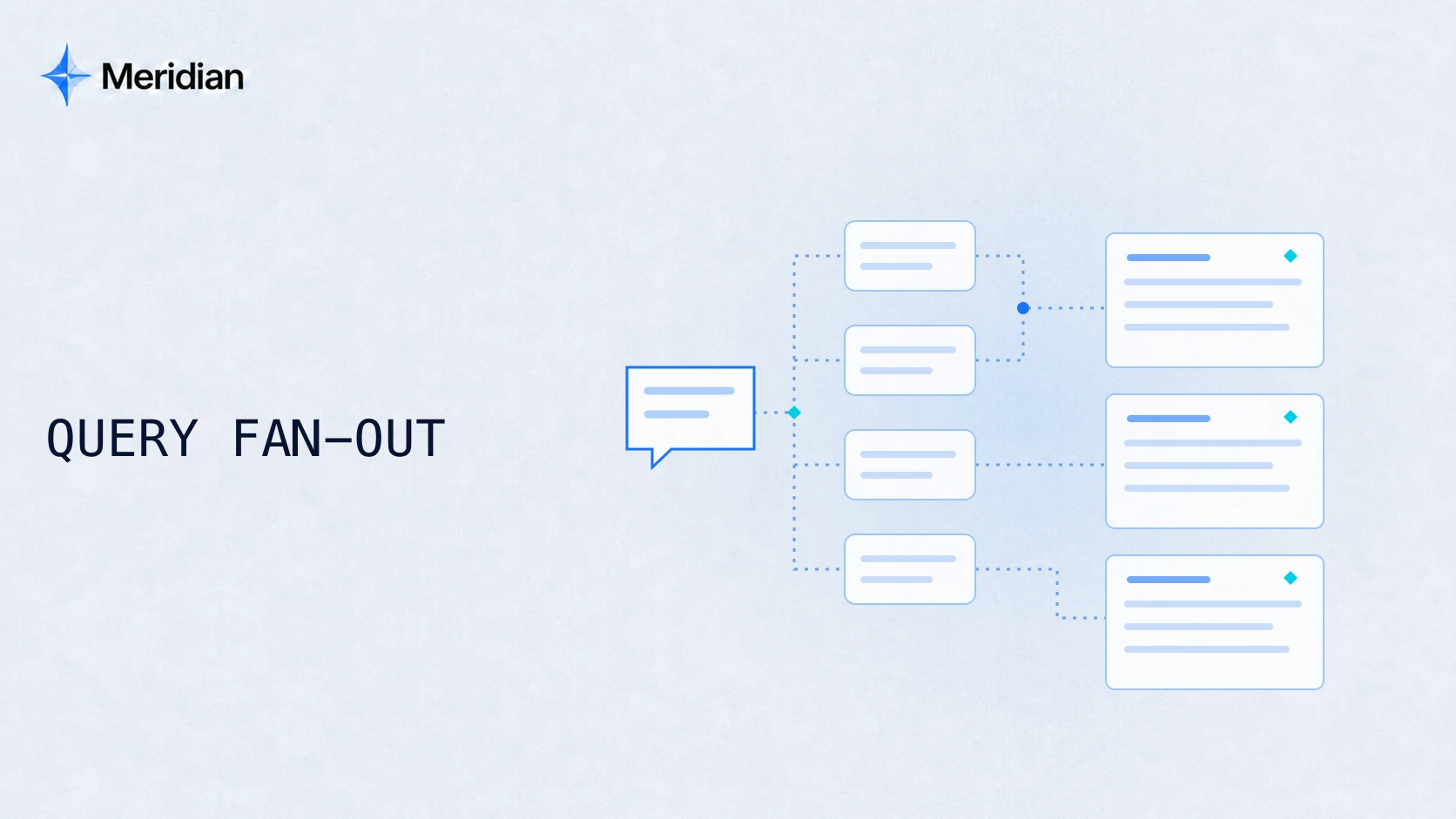
Query fan-out describes how Google's AI search can use related searches to gather information for a user's question. For an editor, it raises a practical question: which parts of a reader's decision belong together, and which need a different page?
This guide works through Meridian's public GEO buying guides. You will see why cost, billing and included work share one destination, why choosing a provider needs another, and why a missing piece of evidence does not automatically justify a new article.
What query fan-out means for this example
Google's generative AI search guidance, checked September 28, 2026, describes query fan-out as a model generating related queries concurrently to retrieve more relevant search results. That describes a retrieval mechanism in Google Search.
An editor can also expand a broad buying question into smaller questions, using available customer and search evidence. That produces a proposed content map. A brainstorm or an AI-generated list, by itself, does not establish which searches a platform actually ran.
Keep those two activities distinct. The example below uses existing public pages and our editorial interpretation of the decisions they support. It is not a captured Google or ChatGPT query sequence, or a transcript of customer interviews.
A query fan-out content-cluster example
Consider the broad question, “How should our team evaluate GEO?” Several related decisions sit inside it. The question wording in this table is our own; the linked pages are published Meridian content, checked September 28, 2026.
Swipe horizontally to compare the questions, pages and reasons.
| Reader's question | Existing destination | Why it belongs there |
|---|---|---|
| What will it cost, how is it billed, and what work is included? | GEO cost and budget guide | These details jointly explain what a proposed budget buys. |
| Which kind of provider fits our team, and who will implement the work? | GEO agency comparison | Choosing a partner requires fit, responsibilities and supporting evidence. |
| What do the changes in our report actually mean? | GEO metrics guide | The immediate task is to interpret observations, referrals and inquiries. |
| Does this justify starting or continuing the investment? | GEO ROI guide | The decision needs costs, attributable outcomes and assumptions about returns. |
| What would working with Meridian involve? | Meridian's GEO service scope | Our own deliverables and collaboration responsibilities belong in our service explanation. |
This map gives the questions primary destinations without creating another URL. It also makes the boundaries easier to review: a provider comparison can summarize cost considerations while leaving the detailed budget explanation in the cost guide.
If your team has a list of questions but no clear page assignments, Meridian's Prompt Search research and page planning explains how we turn that material into content priorities.
Keep budget questions on one page
“How much does GEO cost?”, “Is the fee monthly?” and “Does the price include implementation?” are different sentences, but their answers depend on each other. A price means little until the reader understands the purchase and the work still left to their team.
Our cost guide already distinguishes a one-time diagnosis, a fixed project, ongoing strategy and software. That gives billing and included work a shared context. Splitting them into three short articles would make readers reconstruct the same comparison across several URLs.
For example, a project paid in installments needs its total commitment and project scope explained together. The installment alone cannot tell a buyer what is being delivered. A software subscription similarly needs an explanation of who will interpret its output and implement changes.
The planning decision is to keep these questions with the existing budget answer. If a necessary condition is missing, propose a focused addition there. If it is already clear, keep it. The existence of another question formulation is not, on its own, a reason to add a heading or an article.
Use another page when the decision changes
Once the reader understands the budget, “Which team should we hire?” requires a different answer. The agency comparison considers provider positioning, implementation responsibilities and the evidence behind a proposal. It can point back to the cost guide when the reader needs help comparing commitments.
The distinction between measurement and ROI is just as useful. “Our citations increased—what does that tell us?” calls for an explanation of the metric and its limits. “Should we continue spending?” needs a decision about costs and business outcomes as well. A metrics explanation can support that decision, but it cannot supply missing revenue or attribution evidence.
These pages can share a short explanation of a relevant concept. Their main work remains different. The link should tell the reader what they will get next: help interpreting the report, assessing the investment, or checking a provider's actual scope.
In this example, all those destinations already exist. The useful next action is to check that each page answers its assigned question and offers the appropriate next link. There is no need to invent an additional “GEO buying questions” page to complete the diagram.
Resolve the evidence gap before creating another page
Suppose the next question is “Will this pay back within three months?” This is a hypothetical planning question, not a result from a Meridian client.
The ROI guide already explains how to assess costs and uncertain returns. It can help someone examine that question, but the framework cannot establish a particular company's payback period. That would need relevant cost records, attributable business outcomes and a suitable observation period.
For this question, keep the existing ROI guide as the destination and identify the missing evidence. If usable records become available, decide whether they support an update or a distinct case study. Until then, a new page promising a three-month result would only create an answer the available material cannot support.
That is a different planning outcome from “we need another article.” The subject may matter to buyers while the proposed claim is still premature. A useful content map makes that distinction visible.
Questions about planning a content cluster
Should every related question become a heading?
No. Some questions need only a sentence within an existing explanation. Others depend on a table, a comparison or a separate decision. Google also cautions against creating pages for every query variation primarily to influence rankings or AI responses. Choose the amount of space that lets the reader understand the answer.
How do we know a proposed question belongs in the plan?
Look for support in relevant search observations, available customer questions or someone who can confirm the buying context. Keep editorial suggestions identifiable until that support exists. Then read the proposed destination: a matching title is not enough if the page leaves the important condition unanswered.
Discuss the questions your content needs to answer
Meridian's Prompt Search service helps teams decide which questions to prioritize, what a useful answer needs and which page should address each intent. The research can guide your own writers or connect with article production; the market, language, coverage and deliverables are agreed when scoping the work.
Bring one buying question, the pages you already have and the material you can use. Review our Prompt Search scope and deliverables to discuss the next page decision.