SEO Content Brief Template & Filled Example
Download a free SEO content brief template with a filled example. Define keyword groups, search intent, evidence, outline, and review criteria before writing.
Updated
What is an SEO content brief?
An SEO content brief is a writing document that connects a search need to an article: who the reader is, what they need, which evidence is available, and what the piece should help them do next. It gives the writer a research direction, an outline, and clear review criteria. A keyword and a word count leave most of that work unresolved.
This template is Meridian's working framework for commissioning an article. The filled example below was reconstructed from our own SaaS SEO pricing guide to show how the assignment and finished content connect. It is an editorial teaching example, not a client brief or a record of the article's original drafting process.
Download the template and filled example. The file is editable Markdown with a blank version, the worked assignment, and a handoff checklist. You can use it without booking a call.
Start with the reader and the decision
Describe a reader who has a reason to open this page. “Business owners interested in SEO” is too broad to guide the writing. “A SaaS marketing lead comparing agency proposals while working out what the internal team must still produce” gives the writer a decision to support.
Then state the task in one sentence. For the example: help the reader compare the work, responsibilities, and total budget behind an SEO proposal. This determines the examples, structure, and CTA more usefully than an instruction to repeat a keyword.
Record the primary search need and related questions together. Do not turn every wording variation into a separate article. Check whether an existing page already addresses the task, and name the page this piece should complement. In this example, the pricing guide supports the comprehensive SEO service page; it does not need to reproduce the whole service pitch.
Before handing off the brief, turn that search need into a small keyword group. Record each query's search volume, keyword difficulty, target country, tool, and collection date; mark missing data as unknown. Keep the figures separate rather than adding overlapping query volumes into a promised audience size. For the pricing guide, “SaaS SEO pricing” and “SaaS SEO cost” are candidates for the same budgeting task; “SaaS SEO agency” also involves choosing a provider and needs its own search-result check.
Inspect the results for the main query and the variants that might change the task. Note the page types, questions answered, and actual URLs. Then assign each relevant question to a section, example, or linked page. The title should describe the article's main promise, and the headings should make its answers easy to find. A synonym does not need its own heading when the same section already answers it. The downloadable template includes fields for this research and coverage map.
A filled brief for the pricing guide
| Field | Worked assignment |
|---|---|
| Reader | SaaS marketing lead comparing SEO proposals and internal execution capacity |
| Reader decision | What work belongs in the budget, who owns it, and which costs are additional? |
| Search need | SaaS SEO pricing; related questions about cost, retainers, project work, and included deliverables |
| Page type | Procurement guide with a scope comparison and an illustrative budget |
| Core answer | Count both the partner's work and the people needed to publish and implement it |
| Angle | Explain scope and responsibility before presenting a price example |
| Product input | Meridian's current service descriptions and coaching/managed delivery responsibilities |
| Evidence | Service scope for first-party claims; the dated survey cited by the article for broad historical context |
| Example | A clearly labeled planning calculation with assumptions that readers can replace |
| Exclusions | No universal SaaS market rate, guaranteed return, or claim that a brief equals a finished article |
| Internal links | Comprehensive SEO service, provider-selection guide, and relevant technical support |
| Next action | Compare responsibilities or discuss the website, budget, and available team |
| Visual | A scope/budget illustration; show the calculation's inputs and label assumptions |
| Review | Product owner checks scope; editor checks reasoning, sources, numbers, links, and terminology |
These are instructions derived from the finished article. The search expressions describe its intended demand group; this table is not a new keyword-volume report or a claim that the page already ranks.
Build a source pack the writer can use
A source list should explain what each source supports. For this example, separate three kinds of input:
- First-party scope: the SEO program comparison establishes Meridian's listed work and customer responsibilities. It cannot establish what all agencies charge.
- Historical market context: the pricing article cites Ahrefs' SEO pricing survey. If you reuse a statistic, check its date, population, and method in the source. Broad historical data should not become a current SaaS-specific quote.
- Planning assumptions: the worked budget is an illustration. Its numbers belong in an assumptions field, not in a customer-results field.
For your own brief, add product documentation, approved terminology, interview notes where available, and links to evidence for material claims. Assign an owner to missing information. A writer can flag an unanswered product question; they should not fill it with a plausible feature or invented customer result.
The template includes a source ledger with claim, source, date, intended use, limitation, and reviewer. That lets the editor inspect the argument without repeating the entire research task.
Turn the brief into an outline and a draft
For the pricing example, a useful outline is:
- Explain what belongs in the budget.
- Compare recurring support and a defined project.
- Show the service scope and internal responsibilities.
- Explain what changes the amount of work.
- Walk through a labeled budget calculation.
- End with questions to take into a proposal discussion.
The sequence follows the buyer's decision. A generic introduction to what SEO is would delay the answer this reader came for.
Editing demonstration: “SEO is a great way to grow a SaaS company. Costs vary, so choose the agency that provides the best value.” This rough opening was created for this example. It sounds relevant, but gives the buyer no comparison method.
The finished article begins: “Budget for the agency's work and the people who will turn it into published pages.” It then names research, briefs, finished writing, publishing, and code as separate tasks. The edit works because it replaces a vague value claim with a usable budgeting rule.
Read the full pricing article, or inspect the side-by-side editorial example. A writer should still be able to improve the proposed outline when the evidence suggests a clearer answer; record the reason for a material change.
Specify links, visuals, and review
An internal link should have a job. Name its destination and explain why the reader would need it at that point. “Link to our services” is less useful than “After the scope comparison, link to the complete program so the reader can inspect delivery responsibilities.” Check the destination after publishing.
For each visual, specify:
- The question the image should answer.
- The source material or inputs it uses.
- The labels, units, date, and assumptions that matter.
- Whether it is a diagram, a real product screenshot, or a results chart.
- Who supplies or makes it, permission requirements, and proposed alt text.
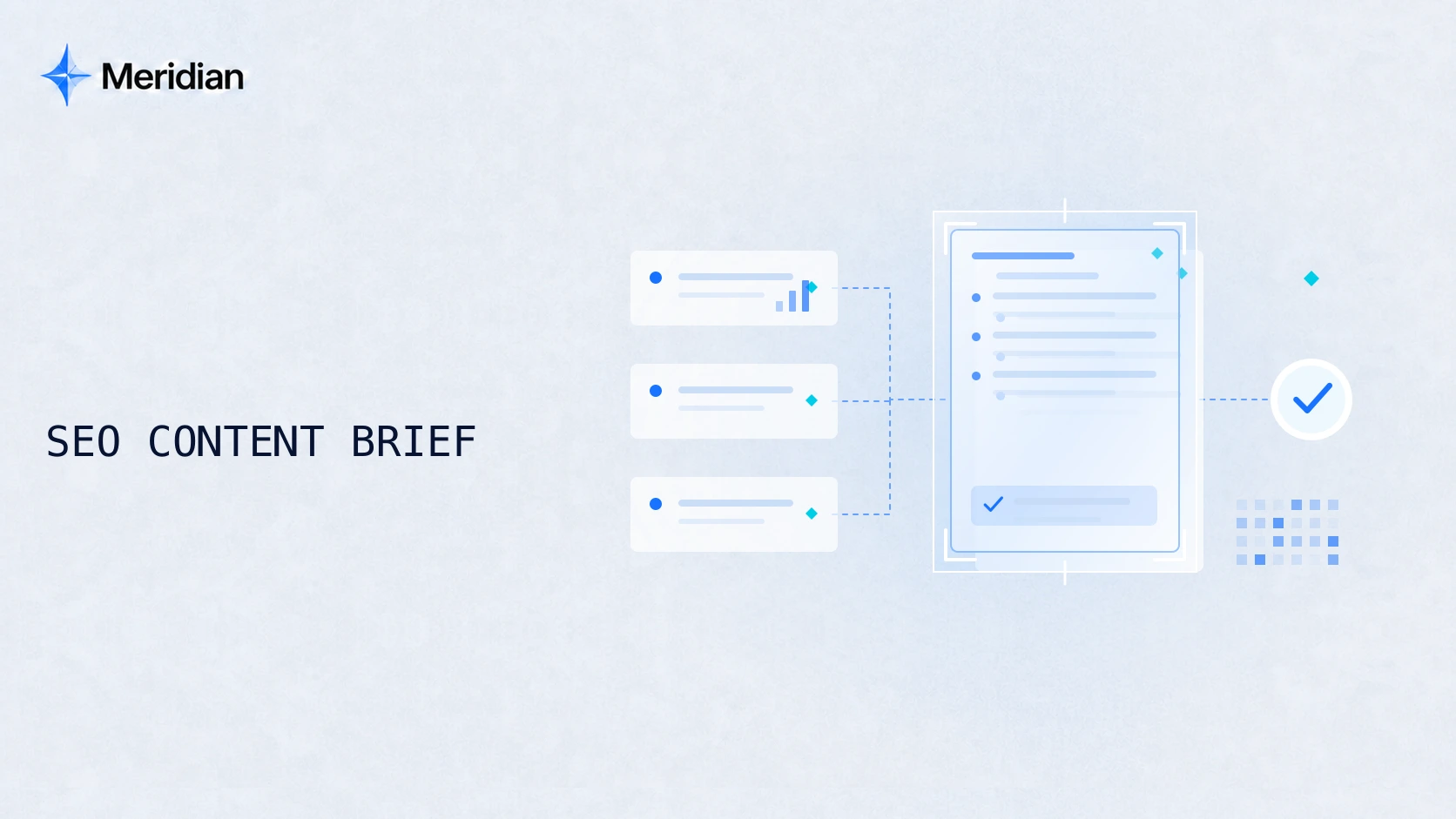
The cover on this guide illustrates the brief-to-draft workflow. It is not a product screenshot or evidence of content performance.
Set an acceptance checklist before writing starts: the main question is answered; material claims have support; product terminology is accurate; assumptions are labeled; links point to the intended pages; and the reader has an appropriate next step. Agree on the reviewer, feedback window, and revision scope. Review should compare the draft to the agreed task rather than restart the assignment with each comment.
Choose the right level of writing support
Use the template with your own writer when your team can research, draft, edit, and publish. If you need the completed article as well as the assignment, SEO content writing services cover a separately defined writing and editorial scope. You can inspect two complete examples before discussing the work.
If the unanswered question is which subjects and pages to build, start with SEO planning and program support. Planning, a brief, a finished article, and a published page are different outputs. The proposal should say which ones you are buying and who completes the others.
Common questions
Is an outline enough?
An outline specifies order. A brief also needs the reader, decision, evidence, product inputs, next step, and review conditions. An outline alone often leaves the writer to guess those details.
Should the brief fix an exact word count?
Use length as a scope estimate where needed, then check whether the piece answers the task. Padding a draft to reach a number can make it harder to use. Agree on any material expansion before adding the work.
Can I use the same brief for both languages?
You can share the reader task and approved facts. Check search wording, local examples, product terminology, links, and review ownership for each market. A translated document is an input to that review, not evidence that the same search demand exists everywhere.