B2B vs AI SaaS vs B2C SEO: Where Organic Traffic Actually Lands
A practical comparison of the URL types, growth methods, technical constraints, and conversion paths behind B2B, AI SaaS, and B2C SEO.
Updated
The Difference Is Not Just the Audience
B2B, AI SaaS, and B2C companies all need crawlable pages, relevant content, internal links, and authority. The fundamentals do not disappear when the business model changes.
What changes is the type of URL that attracts demand and the job that page must do after the visitor arrives.
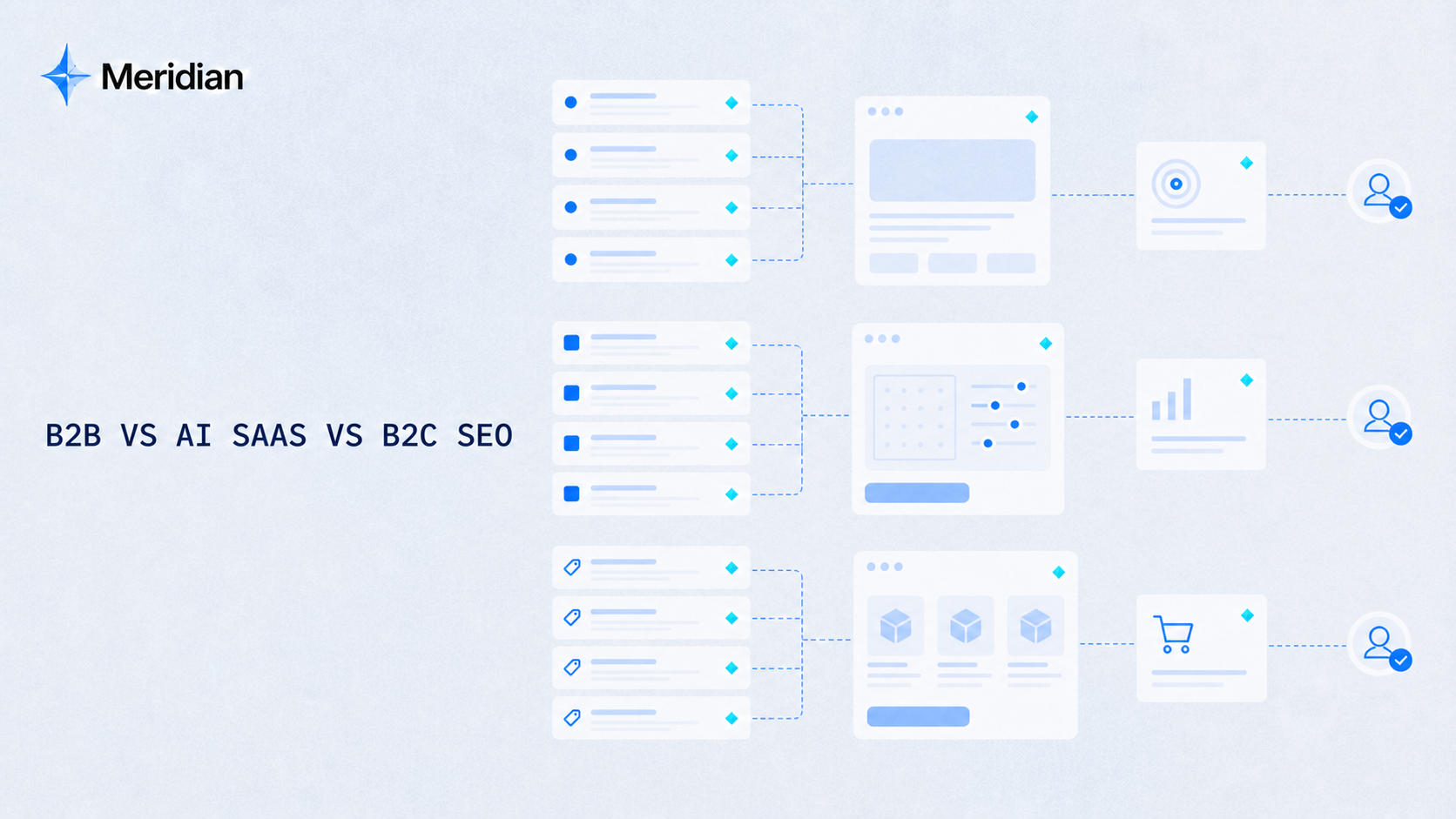
- Traditional B2B companies often build traffic through editorial content, then move visitors toward solution pages, case studies, and sales conversations.
- AI SaaS companies can turn a product capability into a searchable tool page, allowing acquisition and product activation to happen on the same URL.
- B2C ecommerce companies usually capture commercial demand through category and product pages, with the store itself acting as the SEO surface.
That difference affects keyword research, information architecture, content production, engineering requirements, and measurement.
The URL-Level View
| Business model | Common traffic center | High-value commercial URLs | Primary conversion |
|---|---|---|---|
| Traditional B2B | /blog/, /resources/, /guides/ | /solutions/, /industries/, /use-cases/, /compare/ | Demo, consultation, qualified lead |
| AI SaaS | /tools/, /templates/, /integrations/, public product pages | Tool, use-case, comparison, and pricing pages | Tool completion, signup, activation, paid plan |
| B2C ecommerce | /collections/, /category/, /products/ | Category and product pages | Add to cart and purchase |
These are patterns, not fixed rules. An enterprise AI platform may behave more like a traditional B2B company. A consumer subscription app may use AI SaaS-style tool pages even though it sells to individuals.
The useful question is not, “Which SEO category are we in?” It is:
Which URL type can satisfy the search intent, demonstrate the product or offer, and create the shortest credible path to conversion?
Traditional B2B SEO: Editorial Traffic, Commercial Page Value
Where the traffic tends to land
For many B2B websites, the largest share of non-branded traffic lands on educational URLs:
/blog/how-to-reduce-customer-churn
/guides/b2b-demand-generation
/resources/customer-support-benchmarks
/glossary/customer-lifetime-value
This happens because the total search demand around a business problem is usually much larger than the demand for the product category itself.
A company might find thousands of searches around customer retention, while terms such as “enterprise customer retention platform” have relatively limited volume.
But traffic concentration and commercial value are not the same thing.
The URLs most likely to influence pipeline often sit deeper in the buying journey:
/solutions/customer-retention
/industries/financial-services
/use-cases/churn-risk-detection
/compare/product-a-vs-product-b
/integrations/salesforce
/case-studies/customer-name
These pages may receive fewer visits than the blog, but each visit is more likely to come from someone evaluating a solution.
The operating model
B2B SEO is best planned around the buying process rather than content volume:
Business problem
→ possible solution
→ product category
→ vendor evaluation
→ internal validation
→ sales conversation
Each stage needs a different page type. Blog content can create awareness, but solution pages, industry pages, integrations, comparisons, security information, and customer evidence help a buying group make a decision.
The practical work therefore includes more than publishing articles:
- Interviewing sales teams and subject-matter experts
- Mapping recurring objections to landing pages
- Building solution and industry page architecture
- Connecting informational content to relevant commercial pages
- Publishing cases with specific constraints, work, and outcomes
- Attributing organic visits to qualified pipeline instead of counting form fills alone
The common failure mode
A B2B website can grow traffic while producing almost no pipeline. This usually happens when most rankings come from broad, top-of-funnel articles and the site has weak commercial pages.
For a hypothetical example, if /blog/ generates 80% of organic clicks but /solutions/, /use-cases/, and /compare/ generate nearly all qualified leads, the correct response is not automatically to publish more blog posts. It may be to strengthen the smaller set of URLs that creates commercial movement.
AI SaaS SEO: The Product Becomes the Landing Page
Where the traffic tends to land
AI SaaS products can capture search demand through URLs that perform a task:
/tools/youtube-transcript-generator
/tools/pdf-summarizer
/tools/ai-email-writer
/templates/meeting-notes
/prompts/customer-research
/integrations/notion
/alternatives/otter-ai
The visitor is not necessarily looking for an explanation. Someone searching for a “PDF summarizer” usually wants to upload a PDF and receive a summary.
This creates a shorter acquisition path:
Search
→ use the tool
→ receive an initial result
→ register to save, export, or continue
→ reach the product's activation event
Acquisition and product experience can begin on the same URL. That is the defining advantage of tool-led SEO.
The operating model
AI SaaS keyword research should start with searchable jobs, not only category terms.
Useful task modifiers often include:
- Generate
- Summarize
- Transcribe
- Convert
- Analyze
- Extract
- Rewrite
- Translate
- Remove
- Check
The next question is whether the product can complete each task well enough to justify a dedicated page.
A video product, for example, might support:
/youtube-transcript-generator
/video-summarizer
/add-subtitles-to-video
/translate-video-to-english
/remove-background-noise
These should not be identical pages with swapped keywords. Each page needs the appropriate input, output, example, explanation, and next product action.
Why the technical work is harder
AI SaaS SEO is often more engineering-dependent than traditional B2B SEO. Common constraints include:
- Important content rendered only in the browser
- Product functionality hidden behind authentication
- Thousands of empty or low-value generated URLs
- Near-duplicate programmatic landing pages
- Public outputs containing private or unsafe material
- Slow tool execution weakening conversion
- Inference costs created by free organic users
- Marketing pages, documentation, and the application running on separate stacks
The ideal working group is therefore not just an SEO strategist and a writer. It includes product, engineering, and design.
The common failure mode
The usual mistake is treating every possible AI task as a programmatic SEO opportunity.
Generating thousands of pages is easy. Producing thousands of pages that offer distinct value, work reliably, and deserve to be indexed is not.
AI SaaS performance should also be measured beyond rankings and registrations:
Organic landing
→ tool started
→ tool completed
→ signup
→ activation
→ paid conversion
→ retention
A tool page with substantial traffic can still be unsuccessful if visitors cannot complete the task or never experience the core product value.
B2C Ecommerce SEO: Category and Product Pages Capture Demand
Where the traffic tends to land
For ecommerce businesses, organic traffic typically concentrates on commercial inventory pages:
/collections/running-shoes
/collections/womens-waterproof-boots
/category/vitamin-c-serums
/products/product-name
/brands/brand-name
Category pages usually target non-branded product demand. Product pages capture specific models, brands, reviews, and detailed product searches.
Buying guides support the journey but should lead visitors toward inventory:
/blogs/guides/best-running-shoes-for-flat-feet
→ /collections/running-shoes-for-flat-feet
→ /products/product-name
In this model, SEO is closely connected to merchandising. Search demand can influence which collections exist, how products are grouped, and which product attributes deserve indexable landing pages.
Why Shopify makes the basics easier
Shopify reduces the implementation burden for small and medium ecommerce sites by providing much of the underlying infrastructure:
- Hosting, HTTPS, and a CDN
- Product and collection templates
- Sitemap generation
- Basic canonical handling
- Responsive themes
- A structured product catalog
- An app ecosystem for common store functions
As a result, many day-to-day SEO improvements can be implemented without a dedicated engineering team. Teams can update collection copy, product content, metadata, internal links, images, redirects, and structured data within an established system.
Where Shopify SEO becomes difficult
The complexity returns as the catalog and international footprint grow. Typical problems include:
- Duplicate routes created by product and collection paths
- Filter and parameter combinations producing index bloat
- Product variants with substantially similar content
- Out-of-stock and discontinued product handling
- Apps adding excessive JavaScript and slowing templates
- Supplier descriptions reused across many stores
- Pagination and internal-link depth
- Multi-country, multi-language, and multi-currency implementations
Shopify makes foundational implementation easier. It does not automatically solve indexation, page differentiation, inventory changes, or performance at scale.
The operating model
B2C ecommerce SEO is best approached as search-led merchandising:
Search demand
→ category structure
→ collection page
→ relevant inventory
→ product evaluation
→ purchase
The SEO team needs to work with merchandising, inventory, development, and conversion teams. A collection page cannot perform if it ranks but regularly contains irrelevant or unavailable products.
Measurement is also closer to revenue:
Organic landing
→ product view
→ add to cart
→ checkout
→ revenue
How the Three Models Change the SEO Team's Work
Traditional B2B
The main constraint is often access to expertise. The team needs credible content, differentiated commercial pages, customer evidence, and a way to connect organic activity to pipeline.
Typical deliverables include:
- Editorial topic clusters
- Solution and industry pages
- Use-case and comparison pages
- Customer stories
- Sales-assisted conversion paths
- CRM and pipeline reporting
AI SaaS
The main constraint is often access to product and engineering resources. The strongest SEO opportunity may require building a functioning tool, opening part of the product, or creating a controlled programmatic page system.
Typical deliverables include:
- Free tool pages
- Templates and prompt libraries
- Use-case and workflow pages
- Integration directories
- Alternative and comparison pages
- Indexable product outputs with quality controls
- Activation reporting
B2C Ecommerce
The main constraint is often catalog and operational coordination. Search demand, taxonomy, inventory, and on-site conversion need to work together.
Typical deliverables include:
- Category and collection architecture
- Product template optimization
- Indexable filter strategy
- Buying guides
- Product and review structured data
- Inventory and redirect rules
- Organic revenue reporting
How to Diagnose Your Own URL Distribution
Export landing-page data from Google Search Console and analytics, then group URLs by directory:
/blog/
/resources/
/solutions/
/use-cases/
/compare/
/tools/
/templates/
/integrations/
/collections/
/products/
For each group, compare:
- Organic clicks
- Non-branded impressions
- Conversion rate
- Qualified pipeline, activation, or revenue
Illustrative data: the percentages below demonstrate how to read a directory comparison. They are not measurements from a Meridian client. The largest traffic directory need not be the most valuable one:
| URL group | Share of traffic | Share of meaningful conversions | Interpretation |
|---|---|---|---|
/blog/ | 62% | 14% | Strong reach, weak commercial efficiency |
/solutions/ | 11% | 31% | Smaller traffic base with high B2B value |
/compare/ | 5% | 17% | High-intent opportunity worth expanding |
/tools/ | 16% | 33% | Product-led acquisition is working |
| Other | 6% | 5% | Review individually |
This analysis is more useful than asking whether the website needs “more content.” It shows which page system deserves investment.
Turn the page model into a first work queue
Choose one customer task before choosing a directory name. Then record five things for the proposed page:
- Customer and task: who is searching, and what decision or action do they want to complete?
- Related queries: group expressions of the same need without assuming each phrase needs its own page.
- Page job: specify the comparison, explanation, product interaction, or purchase the page supports.
- Evidence and owner: identify the product example, case, inventory, or working feature required, and who supplies it.
- Next step and measurement: define where the reader should go and which action indicates progress.
For example, a B2B product selling meeting software might use a solution page for team documentation, a tool page for generating notes, and a comparison article for evaluating alternatives. These are illustrative choices: check the actual search results and product capability before deciding to build all three.
Our Meridian demand-to-page example shows this process on an actual service website. Related agency queries share a core service page, while pricing and provider-selection questions receive separate guides. The project notes explain the starting point and changes; they do not claim search or lead results for this new arrangement.
Decide what can be produced now
A priority page needs both relevant demand and a feasible production path. A useful tool requires a working product feature. A commercial page needs specific product information and proof. A multilingual page needs appropriate language review. When an input is missing, name it instead of filling a template with generic text.
If your team can execute but needs direction, compare the SEO coaching responsibilities. If it needs broader support, use the partner-selection checklist and budget guide to separate research, production, publishing, and technical work. Bring your product, target customers, and a few representative URLs to discuss the page-planning scope.
The Practical Summary
Traditional B2B SEO is primarily content and sales assisted. Traffic often accumulates in editorial resources, while solution, industry, comparison, and case-study URLs create disproportionate pipeline value.
AI SaaS SEO is primarily product led. Tool, template, integration, and workflow URLs can acquire users and begin product activation in the same session.
B2C ecommerce SEO is primarily catalog and merchandising led. Category, collection, and product URLs capture purchase intent, while platforms such as Shopify reduce foundational technical work but do not remove complexity at scale.
The best SEO strategy is not the one that publishes the most pages. It is the one that chooses the right URL type for how customers search, evaluate, and buy.