ChatGPT Citations Do Not Only Come From Google: Bing Rankings Can Independently Drive Them
Why can a site with almost no Google rankings still be cited heavily in ChatGPT? A real case suggests that Bing indexation and rankings can independently influence ChatGPT citations.

ChatGPT Citations Do Not Depend Only on Google: Bing Search Performance Can Independently Drive Them
When people discuss citation sources for ChatGPT and other AI search products, there is a common assumption:
If a site ranks well in Google, it is more likely to be cited by ChatGPT.
That assumption is often correct. Search engines already handle crawling, content understanding, quality evaluation, and ranking. When an AI system answers a query that needs fresh web information, it can rely on that mature search infrastructure for retrieval and grounding.
But that does not mean ChatGPT citations are only affected by Google rankings.
A case documented by SEO consultant Glenn Gabe showed that a site could have almost no meaningful visibility in Google, yet still be cited heavily in ChatGPT if it had strong indexation and rankings in Bing.
That suggests Bing search performance can become an independent citation path into ChatGPT.
A Strange Case: No Google Visibility, Heavy ChatGPT Citations
In June 2026, Glenn Gabe analyzed the search performance of a YMYL website. The site had a large number of pages, but almost no meaningful visibility in Google:
- Google had indexed more than 45K URLs;
- most keywords were ranking on page seven, eight, or worse;
- the site was getting little to no useful organic traffic from Google;
- it was also absent from Google AI Overviews and AI Mode.

Under a traditional SEO view, a site like that should have very limited exposure in AI search.
But Gabe's analysis of third-party monitoring data showed that the site appeared in more than 90K ChatGPT prompts as a cited source.
That raises the key question:
If Google was not ranking the site, where was ChatGPT finding it?
The Answer May Be Bing
Gabe then checked the site across other search engines. He found that:
- the site had more than 88K URLs indexed in Bing at the time;
- it was ranking in Bing for many relevant queries;
- it also had strong citation visibility in Microsoft Copilot;
- queries where the site ranked well in Bing overlapped clearly with prompts where ChatGPT cited it.
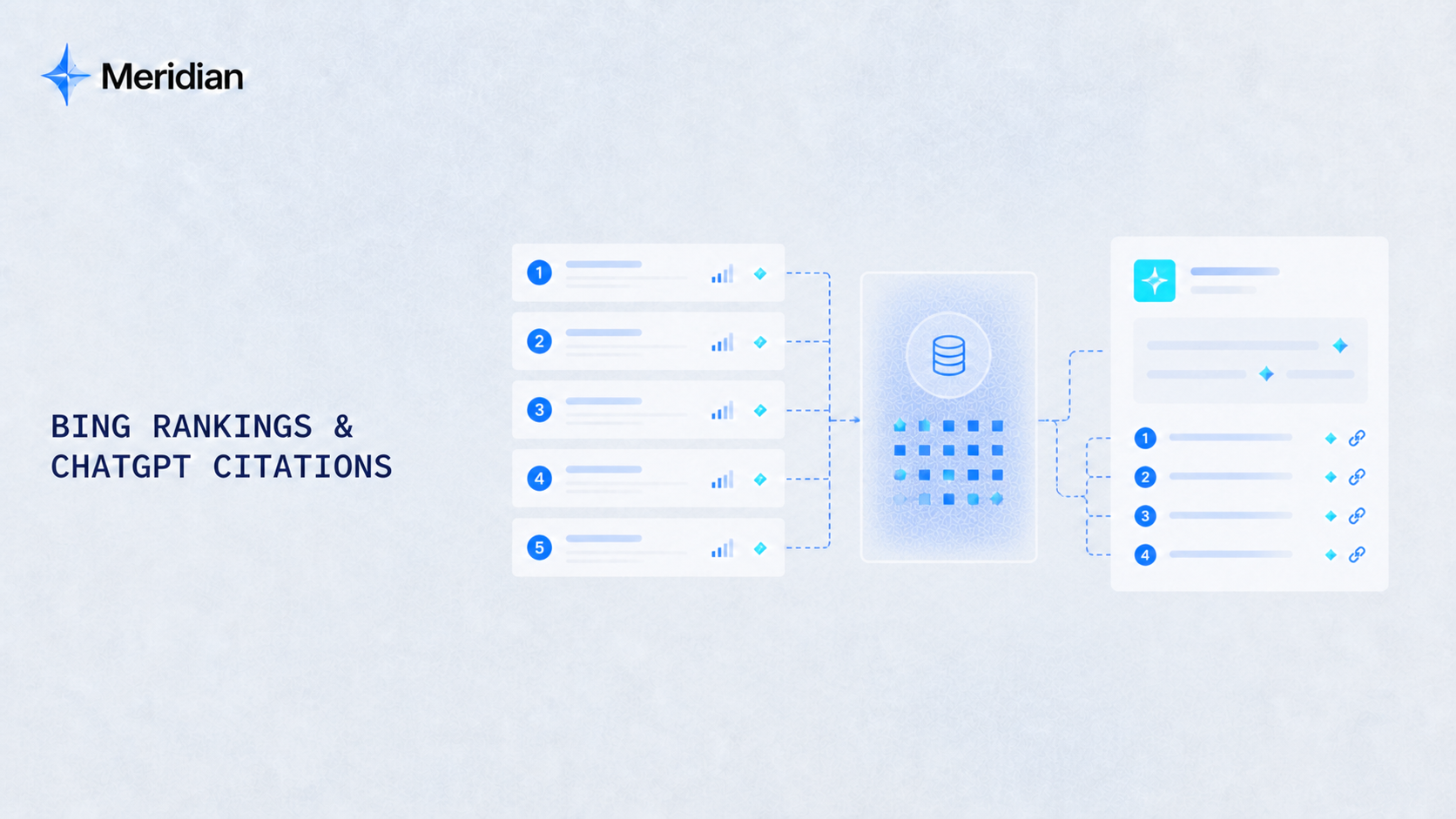
So the more reasonable explanation is not that ChatGPT somehow bypassed search engines and directly “approved” the site. It is more likely that the chain looked like this:
User asks ChatGPT a question
↓
ChatGPT performs live web retrieval
↓
Bing returns relevant search results
↓
The site enters the candidate source set because of Bing rankings
↓
ChatGPT extracts useful content from the page
↓
The site appears as a citation in the final answer
In other words, the site performed poorly in Google but still entered ChatGPT's retrieval flow through Bing's indexation and ranking systems.
That supports an important conclusion:
Google rankings are not the only prerequisite for earning ChatGPT citations. Bing performance can independently drive citations outside Google.
The Original Case and the Important Update
Original source:
There is also an important later update that makes the conclusion more precise.
In an August 2026 update to the case study, Gabe added that the site was later deindexed from Bing almost entirely, yet ChatGPT citations did not disappear immediately and even continued to rise for a period of time. That means the most accurate interpretation is:
- Bing is a clear and important citation source;
- but ChatGPT's citation system cannot be reduced to “Bing ranking equals ChatGPT citation”;
- OpenAI may also combine other third-party search sources, public web discovery systems, or other retrieval paths that have not been fully documented.
So the point of this article is not that every ChatGPT citation comes from Bing. The point is:
ChatGPT citation sources are not limited to Google, and Bing is one of the most important independent paths to pay attention to.
ChatGPT Citation Sources Are Not a Single Search Engine
We should not oversimplify this case into “all ChatGPT citations come from Bing”.
OpenAI explains that ChatGPT Search may work with third-party search providers and may rewrite a user question into one or more more-specific searches. OpenAI also operates OAI-SearchBot to discover and present public web content.
A more accurate mental model looks like this:
ChatGPT citation sources
├── third-party search providers
├── search infrastructure such as Bing
├── public web discovery via OAI-SearchBot
├── direct webpage access
└── other retrieval and content sources that are not fully documented
For any specific prompt, OpenAI has not published the full source mix or weighting logic.
Still, the public Microsoft-OpenAI relationship and the overlap between Bing rankings and ChatGPT citations in this case are enough to show one thing clearly:
If you are doing ChatGPT SEO, you cannot only look at Google.
References:
- OpenAI: ChatGPT Search FAQ
- OpenAI: Publishers and Developers FAQ
- Microsoft: Elevating the Role of Grounding on the AI Web
Google Indexation, Google Rankings, and ChatGPT Citations Are Three Different Things
This case also highlights three concepts that are often blurred together.
1. Being indexed by Google
This means Google has discovered and processed the page. It does not mean the page will rank well. In this case, the site had more than 45K indexed pages in Google but almost no meaningful search visibility.
2. Ranking in Google
This means the page has passed Google's relevance and quality systems strongly enough to earn meaningful exposure. The site in Gabe's example did not achieve that.
3. Being cited by ChatGPT
This means the page entered ChatGPT's candidate source set through some retrieval path and was chosen to support the final answer. That path may go through Google, Bing, or some other source.
So:
- Google indexation does not equal Google rankings
- Google rankings do not equal ChatGPT citations
- no Google rankings does not equal no chance of being cited by ChatGPT
That last point is the most valuable lesson from the case.
Why Bing SEO Matters Again
For years, many SEO teams treated Bing as a secondary search engine with limited direct traffic share.
In the AI search era, Bing's value cannot be judged only by the clicks that come from bing.com. It may also act as retrieval and grounding infrastructure for other products, including:
- ChatGPT;
- Microsoft Copilot;
- AI products that use Microsoft search and grounding services;
- other assistants that rely on Bing-connected data sources.
Microsoft describes grounding as the infrastructure that connects AI systems to real-time and authoritative information.
That means a page ranking in Bing may create two types of value:
Bing rankings
├── direct search traffic from Bing
└── downstream citations and brand visibility in AI products
That is why Bing SEO deserves to be re-evaluated in an AI search environment.
This Case Does Not Validate Low-Quality AI Content
It is important to say clearly that the site in Gabe's example is not a positive model to copy.
According to his analysis, the site showed several obvious quality problems:
- scaled AI-generated content;
- missing author and reviewer information;
- no clear company information;
- little to no contact information;
- YMYL subject matter;
- many pages that looked like low-value scaled content.
More importantly, Gabe later noted that the site went from roughly 90K indexed URLs in Bing to being almost completely removed from the Bing index.
So the case proves that Bing can independently drive ChatGPT citations. It does not prove that large-scale low-quality content is a sustainable strategy.
If anything, it also reveals another risk:
If AI visibility depends entirely on short-term rankings in one external index, that visibility can disappear when the underlying index changes.
What Should Companies Do?
1. Do not rely only on Google Search Console
At minimum, teams should monitor:
- Google Search Console;
- Bing Webmaster Tools;
- ChatGPT referral tracking;
- AI citation monitoring.
Key questions include:
- Are important pages indexed in both Google and Bing?
- How do rankings differ across the two engines for the same queries?
- Which pages are being cited by ChatGPT?
- Do those citations correlate with Bing rankings?
- Are citations driving visits, brand search, or conversions?
2. Make sure Bing can crawl important pages
Check:
- whether
robots.txtblocks Bingbot; - whether CDN or WAF rules mistakenly block Bingbot;
- whether important pages return correct HTTP status codes;
- whether the sitemap includes the right URLs;
- whether canonical signals are correct;
- whether JavaScript content renders correctly;
- whether important pages have crawlable internal links.
3. Allow OAI-SearchBot to access public content
If you want public pages to have a chance of appearing in ChatGPT Search summaries and citations, make sure OAI-SearchBot is not blocked by mistake.
OpenAI states that any public website can potentially appear in ChatGPT Search, although visibility and ranking are never guaranteed.
4. Track Google, Bing, and ChatGPT separately
Do not collapse “search performance” into a single metric.
| Channel | Core metrics | | --- | --- | | Google | indexation, rankings, clicks, conversions | | Bing | indexation, rankings, clicks, Copilot citations | | ChatGPT | cited pages, prompt coverage, referral traffic, citation context | | Other AI search | mentions, citations, visits, conversions |
That split helps teams answer questions like:
- Are ChatGPT citations mostly driven by Google?
- Are some citations independently driven by Bing?
- Which content works in one search ecosystem but not another?
- How do changes in rankings affect AI visibility downstream?
The Real GEO Lesson
Many GEO service pitches focus on paragraph length, Q&A formatting, schema, or “AI-friendly writing”.
Those things may help systems understand and extract content more clearly. But they cannot replace the basic requirement of being present in the retrieval layer.
If a page never enters the search index or retrieval system being used, it has little chance of being selected later.
A better model for ChatGPT citations is:
machine access
×
indexation
×
query rankings
×
extractable content
×
source selection
=
ChatGPT citation opportunity
And “query rankings” should not be understood as Google rankings alone. Bing rankings can also determine whether a page becomes part of ChatGPT's candidate source set.
Suggested Internal Links
After publishing, these internal links would fit naturally:
Conclusion
The most important conclusion from this case is straightforward:
ChatGPT citation sources are not shaped only by Google search performance. Even if a site has almost no rankings in Google, it may still earn substantial ChatGPT citations if it gains strong indexation and query visibility in Bing.
That does not mean companies should abandon Google and only do Bing SEO. It also does not mean every ChatGPT answer is powered by Bing.
It means that in the AI search era, teams need to evolve from “Google SEO” to “multi-index search visibility”:
- Google shapes part of search and AI visibility;
- Bing can independently shape another part;
- OAI-SearchBot creates another web discovery path;
- ChatGPT then performs retrieval, extraction, and citation from the sources it can access.
So in the future, the question cannot only be:
Where do we rank in Google?
It also needs to be:
Are we present in the search and retrieval systems ChatGPT actually uses?
Bing is one of the most important answers to that question right now.
FAQ
Do all ChatGPT citations come from Bing?
No. ChatGPT Search may use third-party search providers, OAI-SearchBot, and other retrieval methods. The full source mix has not been publicly documented. The point here is that Bing can be an important citation path independent of Google.
Can a site be cited by ChatGPT without ranking in Google?
Yes. This case suggests that if a page ranks in Bing or another retrieval source used by ChatGPT, it may still be cited even with very little Google visibility.
Does Bing indexation guarantee ChatGPT citations?
No. Indexation only makes a page eligible for consideration. It still needs to match the query and pass later filters around relevance, content quality, and source selection.
Should companies deliberately invest in Bing SEO now?
Yes, but as part of a broader SEO strategy, not as a replacement for Google. The practical goal is to improve discoverability across Google, Bing, and AI retrieval systems instead of relying on one index.
How can you tell whether ChatGPT citations are likely driven by Bing?
Compare:
- the pages cited by ChatGPT;
- the prompts or questions associated with those citations;
- the page's rankings in Google;
- the page's rankings in Bing;
- whether the same pages are cited in Copilot.
If a page is weak in Google but strong in Bing, Copilot, and ChatGPT, Bing is likely an important retrieval path.
Related blogs
Related Post
Expand your knowledge with these hand-picked posts.

Listicles and GEO: Why Structured Lists Are Easier for AI to Cite
List structure can improve extraction, but it does not guarantee citations. Learn how evidence, structure, crawlability, and source selection interact in generative engine optimization.
Yiwei

How to Find GEO Competitor Sites Worth Studying: Five Measurable Signals
Use AI Overview share, cited-page scale, growth rate, SEO/GEO correlation, and AI channel mix to identify GEO competitors worth analyzing.
Yiwei

SaaS SEO Pricing: What Teams Actually Pay and What Drives Cost
A practical guide to SaaS SEO pricing in 2026, including common retainers, project scopes, cost drivers, and how to evaluate agency proposals.
Yiwei
Earn Visibility in AI Search
Build citable content, technical foundations, and authority signals that help AI search platforms discover and reference your brand.