Black-Hat SEO Agency Risks: Scaled Content, Spam Links, and False Promises
Why can rapid SEO growth disappear? Learn how to evaluate scaled content, link spam, and site reputation abuse using Google policies and a practical vendor audit checklist.
Updated
The short answer: unusually fast SEO results require a method audit
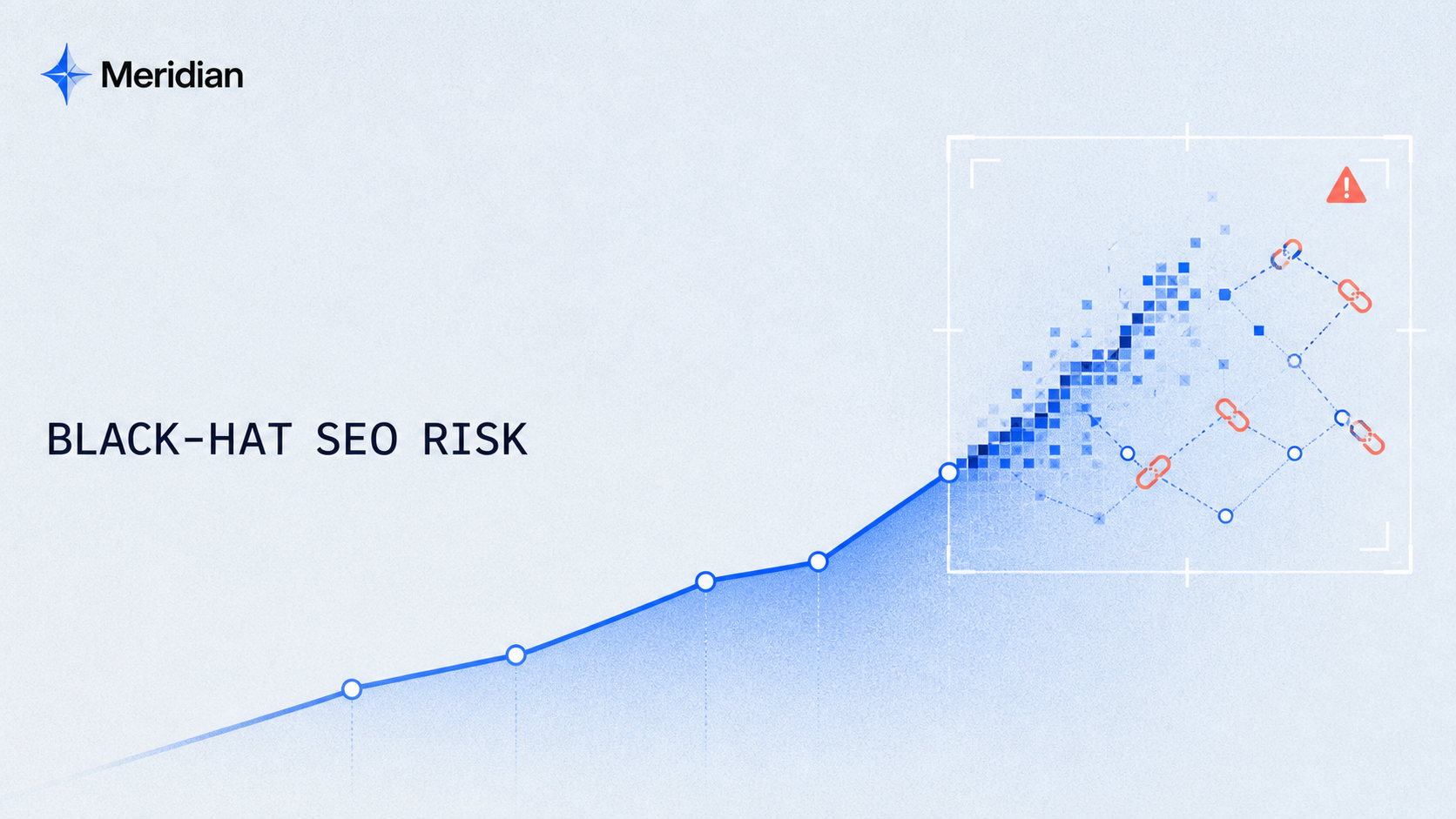
An agency that creates short-term growth through large numbers of low-value pages, manipulative links, or borrowed third-party site reputation can expose a client to ranking losses, manual actions, or removal from search results. Do not judge a provider only by new pages, links, and traffic. Require it to disclose page value, link sources, publishing cadence, and a recovery plan.
The policy definitions referenced below come from Google's spam policies.
Why short-term traffic can conceal long-term risk
Agency contract cycles and the time it takes for risk to materialize are often misaligned. A vendor may publish hundreds of pages, buy links, or place third-party advertorials in the first month, creating a temporary rise in indexing and visibility. Algorithmic reassessment or a manual action may happen later. Google says that understanding site-wide improvements can take months and that search positions are not fixed. See its core update guidance.
First-month growth proves only that metrics changed. It does not prove the growth is durable or the method compliant.
Three deliverables that require close review
Scaled, low-value content
Google defines scaled content abuse as generating many pages primarily to manipulate rankings rather than help users. The production method—AI, scraping, translation, or human writing—is not the deciding factor. A lack of added value and a ranking-manipulation purpose are what create the risk.
Programmatic SEO is not inherently a violation. The test is whether each page has independent data, a clear need, and a real use. Review our programmatic SEO service, then ask:
- What distinct problem does each template solve?
- Where does the data come from and how often is it updated?
- Beyond keywords, how are the pages different?
- Would the page still help someone who did not arrive from search?
Link spam
Google considers links created mainly to manipulate rankings to be link spam. Examples include paid ranking links, large-scale link exchanges, low-quality directories, and automated links. Paid, sponsored, and user-generated links should use attributes such as rel="sponsored" or rel="ugc" when appropriate. See Google's link qualification guidance.
DR and DA are third-party metrics, not official Google ranking scores. A report that says “500 new backlinks” while withholding source pages, relevance, and acquisition methods does not demonstrate quality.
Site reputation abuse
Third-party content may constitute site reputation abuse when it ranks by exploiting the host site's established signals while the host provides little oversight. A common example is a commercial article placed in a high-authority publisher's subdirectory mainly to borrow domain reputation.
Publishing a genuinely edited, audience-relevant article in industry media is not automatically a violation. The boundary is determined by content control, editorial responsibility, and primary purpose.
How to audit an SEO provider
| Deliverable | Required evidence | High-risk signal |
|---|---|---|
| Content | Search intent, author/reviewer, sources, complete page list | Hundreds of near-identical pages launched overnight |
| Backlinks | Source URL, acquisition method, destination, anchor text | Vendor hides domains or promises fixed DR |
| Technical changes | Change log, rollback plan, affected scope | Canonical or robots changes without approval |
| Reporting | Conversions, useful rankings, indexing, risk notes | Only impressions and page counts |
| Promises | Assumptions, time range, uncontrollable factors | Guaranteed number-one ranking or fixed traffic |
Google's SEO Starter Guide says there is no secret that automatically ranks a site first and no guarantee a particular site will be indexed. A provider can commit to execution quality, but it cannot honestly guarantee search-engine outcomes.
Check a link delivery record
Before accepting a link report, open a sample of the source pages yourself. A domain name or screenshot alone cannot show where a link sits, whether it is still present, or where it sends the reader.
- Check the source and destination. Open the exact source URL, find the link in the article, and follow it. Record the final destination if it redirects.
- Read the surrounding paragraph. Identify the audience and the reason to visit the destination. A high domain score does not establish that relationship.
- Check how the link was obtained. Ask for the contribution, editorial arrangement, or disclosed commercial terms. Record the anchor text and observed link attributes. Google recommends
sponsoredfor paid placements andugcfor user-generated links in its link qualification guidance. - Reconcile the status. Outreach sent, pending review, and live and checked are separate states. A submission receipt is not a published backlink. Record the verification date and any changes or removal.
- Agree the follow-up. Specify the review period, who handles issues, and what happens when a placement changes. Assess target-page performance and tracked referrals separately from the delivery count.
Use the blank link review template to collect those fields. For a worked opportunity comparison and an illustrative report, see our SaaS link building services. The examples explain the method; they are not customer placement records.
What to do after discovering risk
- Freeze new production. Pause bulk pages and links while preserving delivery records.
- Check for manual actions. Review the Manual Actions report in Google Search Console. See the report documentation.
- Classify URLs and links. Separate valuable, improvable, removable, and uncontrollable items.
- Fix the system. Deleting pages without changing the generation process allows the risk to return.
- Document material changes. Record dates, templates, link treatment, and quality reviews.
- Request review or wait for reassessment. Use the official reconsideration process for a manual action. There is no button to accelerate an algorithmic recovery.
Common misconceptions
A new domain erases the problem
If the low-value templates, link strategy, and content process remain, a new domain merely repeats the same risk while discarding legitimate brand and link equity.
All programmatic SEO is black hat
It is not. A useful database, location directory, or integration library can be legitimate if every page provides distinct, maintainable value.
Any use of AI writing violates policy
Google policies focus on purpose and value, not the name of the tool. Mass-producing pages with no original value creates risk; using AI to assist research followed by expert verification is not automatically a violation.
FAQ
Does black-hat SEO trigger an immediate penalty?
Not necessarily. Manipulative tactics may grow before algorithmic or manual systems identify them. Google publishes no fixed detection timeline, so a short period without decline does not prove safety.
Should I reject every link-building service?
No. Digital PR, original research, and genuine industry partnerships can earn legitimate links. Reject links whose main purpose is ranking manipulation, whose sources are hidden, or whose placement is automated at scale.
How long does white-hat SEO take?
There is no universal timeline. Google says changes may show within days or take several months and may not produce a noticeable result. Measure crawling, indexing, relevant rankings, and business conversions in stages.