GEO Content Examples: Three Ways to Answer Buyer Questions
Explore GEO content examples for service descriptions, commercial comparisons, and evidence. See published excerpts and the editorial choices behind them.
Updated
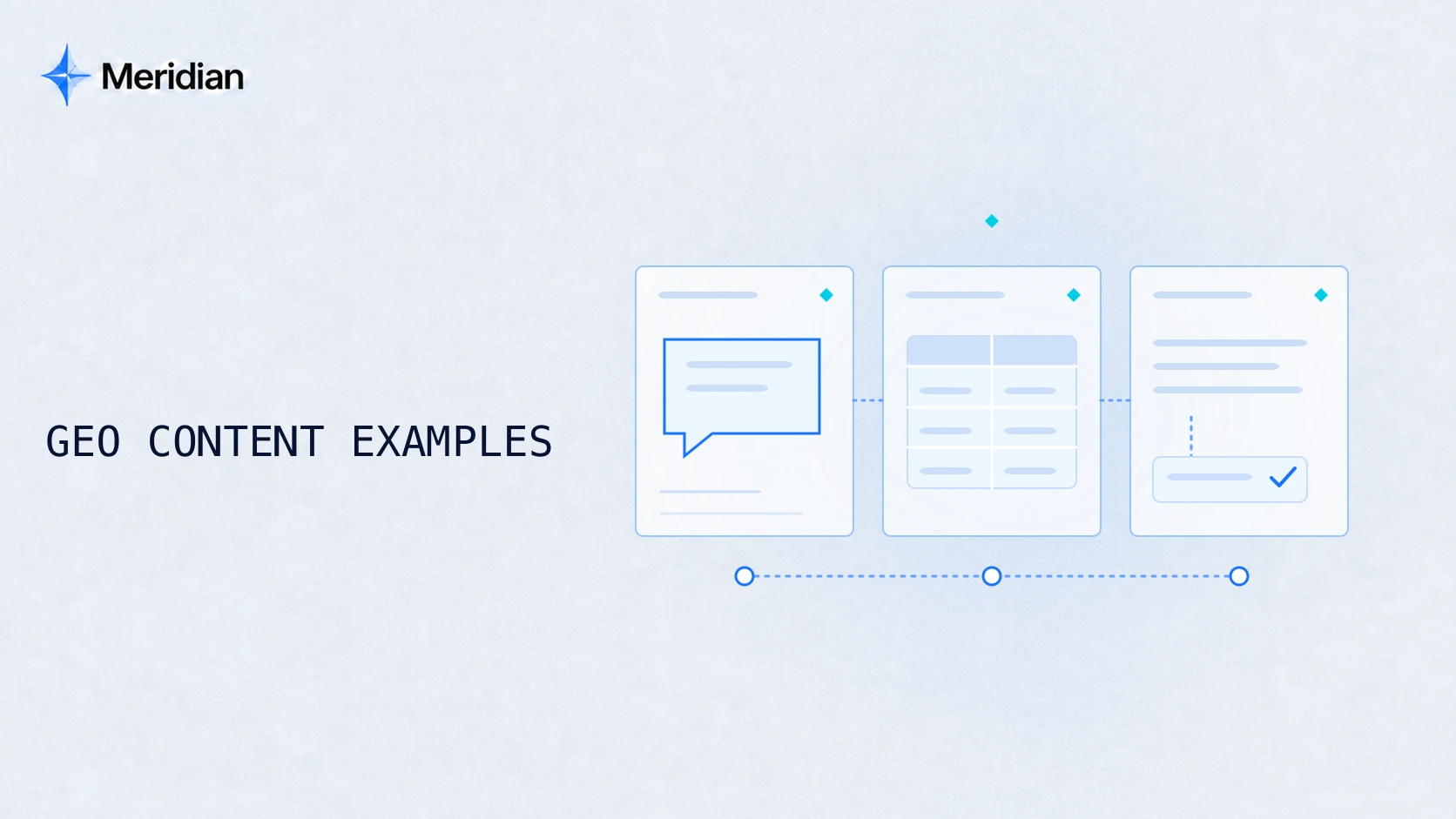
Useful GEO content examples show how a passage helps someone understand an offer, compare options, or judge a claim. If you are looking for an example of content for AEO and GEO, start with the decision the reader needs to make.
Below are three examples drawn from Meridian's public pages, with short explanations of the editorial choices. The service example includes an actual revision; the comparison and evidence examples are adaptations of published material, with invented counterexamples labelled separately. These are writing examples, not evidence that the passages earned AI citations.
GEO content examples start with a reader's question
The right form depends on what is missing from the reader's understanding:
- A service explanation answers what the buyer receives and what it helps them decide.
- A commercial comparison makes differences in scope, billing, and responsibility visible.
- An evidence paragraph separates what was observed from what can reasonably be concluded.
Each example below adds information the reader can use. Adding a heading, a table, or an impressive statistic would not, on its own, supply that information.
Google's guidance for generative AI features in Search, checked September 28, 2026, emphasizes useful, distinctive content and clear organization. It does not require a special writing style, fixed content chunks, or special schema for its AI search features. That guidance concerns Google Search; it is not a promise about how every AI platform selects sources.
Example 1: explain what the service delivers
Reader's question: “What will our team receive, and what can we do with it?”
Meridian's article-production page shows an actual September 2026 revision to our monitoring-service introduction. These short excerpts come from that published before-and-after example.
Before — excerpt from the original wording:
Each review connects answer evidence to content changes
After — excerpt from the revised wording:
A managed monitoring and analysis service with written reviews, supporting observations, and clear recommendations.
The original excerpt describes a connection between activities. The revision names things a buyer can expect to receive: written reviews, observations that support them, and recommendations. The rest of the revised introduction explains their purpose: understanding changes, identifying what needs confirmation, and choosing pages that deserve attention.
Why this helps: a prospective customer can now ask whether those deliverables fit the team's needs. The improvement is specific information about the offer, rather than a stronger adjective or a claim that the service is “AI optimized.”
The opening still cannot carry every contractual detail. Agreed coverage and responsibilities belong in the surrounding service explanation. The edit did not add a new price, a customer result, or a visibility guarantee. See the complete service-description revision for both passages and their context.
If an existing service page leaves buyers unsure what they will receive, that is a useful starting point for a discussion about GEO article production and editorial review.
Example 2: compare the purchase, not just the number
Reader's question: “Are these offers comparable, and what would our team still need to do?”
Invented counterexample for this article — not a historical draft:
Provider A is cheaper than Provider B, so it is the better GEO option.
The sentence offers a conclusion before establishing what either price buys. Our published GEO pricing guide instead distinguishes a one-time diagnosis, fixed project work, ongoing strategy, and software. Its dated supplier offers illustrate different purchases, not a market-average price range.
The following editorial adaptation keeps that distinction visible without repeating changing prices or presenting a new supplier ranking.
Swipe horizontally to compare the purchase and the remaining question.
| Type of offer | What the description needs to make clear | Question the reader can now ask |
|---|---|---|
| One-time diagnosis | A fee for identifying issues and recommending work | Does this proposal include implementing the changes? |
| Fixed project | The total commitment, period, and agreed work; installments are a payment schedule | What will be completed within this project? |
| Ongoing strategy | The recurring fee, term, and included responsibilities | Which work is included, and which items are additional? |
| Software subscription | Access to a tool within its plan limits | Who will interpret the findings and do the content work? |
Why this helps: the rows expose differences that affect the decision. The reader can distinguish a payment schedule from the length of an engagement, or a tool subscription from work delivered by a team. A lower figure does not resolve those differences.
Unknown information also needs an accurate label. In our GEO agency comparison, “Request a quote” means the linked page did not show a package fee when checked. It does not mean the service is free, expensive, or interchangeable with another provider's offer. The article also separates publicly described capabilities from what an eventual contract includes.
These source guides date their supplier checks to September 23, 2026. Use them to understand the comparison and follow their source links to confirm current terms before purchasing. This example adds an explanation of the writing choices; it does not update those offers.
Example 3: keep the conclusion within the evidence
Reader's question: “What does this observation tell us, and what remains unknown?”
Our GEO measurement guide includes an expressly hypothetical situation: relevant mentions increase and service descriptions become clearer, while identifiable AI referral traffic shows no clear improvement and there is no evidence of more qualified inquiries.
Invented overclaim based on that hypothetical situation — not a real report:
More relevant mentions prove that the content generated new customers.
A supported way to describe the same hypothetical situation:
In the observations reviewed, the business appears more relevant and its services are described more clearly. A commercial effect has not yet been established: identifiable AI referral traffic has not clearly improved, and there is no evidence of more qualified inquiries.
Why this helps: the revised paragraph preserves both the favorable observation and the limit. A reader can recognize a change worth investigating without treating it as proof of acquisition or revenue. The phrase “in the observations reviewed” keeps the claim within the available scope.
The next sentence can still be useful: “This is a reason to examine whether important buying questions are answered on the landing pages and whether inquiry records provide enough context.” That is an editorial recommendation for what to examine, not a claim that a content change caused the observed difference.
No percentage or invented customer story is needed to make the paragraph concrete. Its value comes from stating the observation, explaining what it supports, and leaving the unanswered business question visible.
Questions about using these examples
Should every article contain all three formats?
No. Use the form that helps answer the question. A short service explanation may need two clear paragraphs; a comparison may benefit from a table; a report may need a qualified conclusion. Adding every format can make a simple answer harder to read. Our guide to list-style content addresses that particular format in more detail.
Does improving a passage require a new AEO or GEO page?
Not necessarily. If an existing page already serves the same reader and decision, the useful change may be a better explanation or a clearer comparison on that page. A separate article makes more sense when it answers a distinct question with enough substance of its own. Different search wording alone is not the reason to create another page.
Discuss the content your buyers need
Meridian's full GEO program includes 30 articles per month, typically 800–2,000 words each, with languages, formats, review rounds, and publishing responsibilities agreed before production. The work includes writing direction, reviewed copy with relevant sources, and a practical publishing handoff; your team confirms business facts and approves the final version.
Bring an existing page and the question it leaves unanswered. See our GEO article-production scope and deliverables to discuss what kind of content would help your readers make that decision.