GEO KPIs: How to Read an AI Visibility Report
Understand GEO KPIs, from brand mentions and citations to referral traffic and qualified inquiries. Learn what an AI visibility report can actually tell you.
Updated
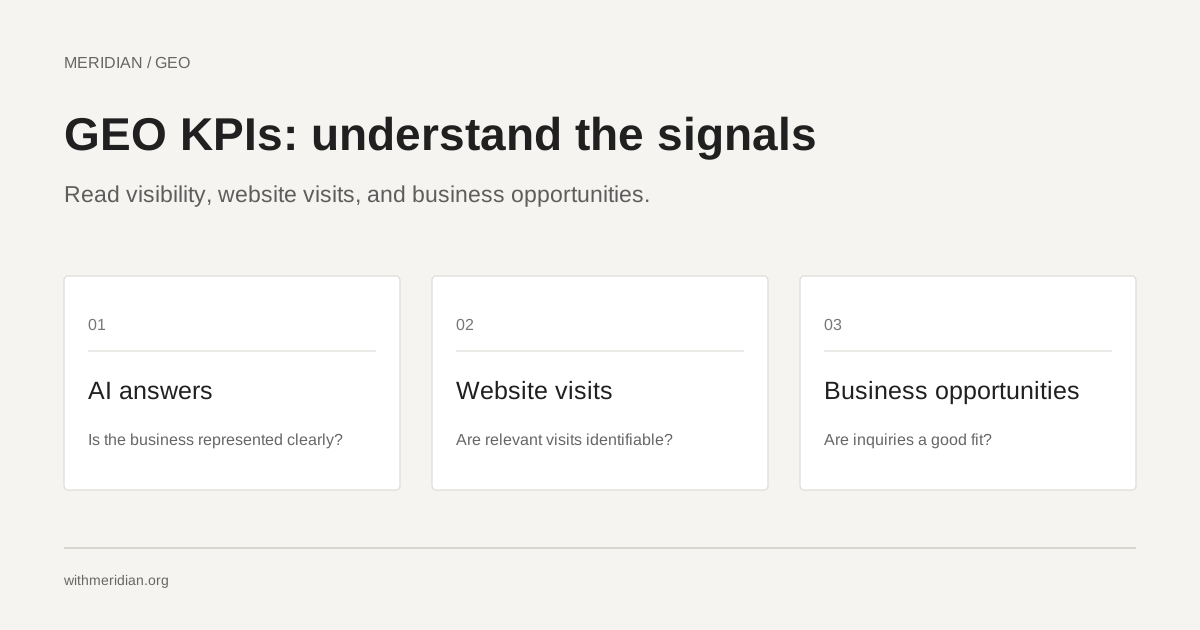
GEO KPIs should help you understand whether AI answers represent your business accurately, whether people reach your website, and whether those visits lead to relevant inquiries. This guide explains the main metrics and how to read a monthly report without confusing visibility with business results.
Start with the decision you need to make. A team correcting misleading product descriptions needs different evidence from a team evaluating new leads. Both can use GEO reporting, but one headline score will not answer both questions.
GEO KPIs: what does each metric tell you?
The following distinctions make a report easier to interpret. They are practical reading guidance; a provider should explain its own definitions before you compare its figures with another tool.
Swipe horizontally to view all three columns.
| Metric | What it helps you understand | What it does not establish |
|---|---|---|
| Brand mentions | Whether your business appears in the answers reviewed | That the answer recommends your business |
| Recommendations | Whether an answer presents your offer as a relevant option | That the recommendation is accurate or reaches your target buyers |
| Citations | Whether an answer links to your website or another source discussing you | That someone clicked through to your website |
| Factual accuracy | Whether descriptions match confirmed business information | That accurate information is widely seen |
| AI referral traffic | Whether analytics identifies visits from an AI source | Every visit or decision that AI may have influenced |
| Qualified inquiries | Whether inquiries meet your agreed customer and need criteria | That GEO alone caused the inquiry or a sale |
A citation to your service page and a citation to a third-party article mentioning your company are also different. Both may be relevant, but only the first points directly to your website. The report should make that distinction understandable.
Accuracy deserves attention even when the visibility figures look encouraging. An answer that recommends a capability you do not offer can create unsuitable inquiries. More mentions are useful only in the context of the audience, the question, and what the answer says.
If you first need to understand where descriptions or website information are unclear, our GEO audit guide covers that earlier diagnostic task.
When is a change worth paying attention to?
Before interpreting a percentage, ask what it is a percentage of. A share of reviewed answers and a share of all brand mentions describe different things. A chart labelled only “visibility” leaves that question unanswered.
Comparisons also need enough context to be meaningful. The reporting period, platforms, markets, and broad topics should be clear. If the scope changed between reports, a higher score may partly reflect that change. It should not automatically be presented as an improvement in performance.
Look for a pattern that remains relevant to your business, supported by examples the reviewer can explain. A single favorable answer can help illustrate a finding, but it cannot stand in for the whole picture. Missing information should be labelled as unavailable, rather than silently treated as zero.
Different sources also describe different audiences. Google's Search Generative AI performance reports, checked September 22, 2026, provide dedicated views of URL impressions in its generative AI features. Those impressions are not measurements of ChatGPT recommendations, and they should not be added to a third-party visibility score as if they were the same unit.
How do AI referrals connect to inquiries?
ChatGPT referral traffic is a useful signal of visits your analytics can identify. OpenAI's publisher FAQ, checked September 22, 2026, explains that ChatGPT includes source tracking in referral URLs. That supports identifiable inbound-traffic reporting; it does not make every AI-influenced customer journey visible.
Keep the analytics question clear. Google Analytics distinguishes the source of a session from attribution credit for a key event. A report about visits and a report assigning credit for inquiries may therefore answer different questions. See Google's traffic-source scope definitions, checked September 22, 2026.
Then ask whether the inquiries are relevant. A contact-button click is an expression of interest; a received inquiry is a further step. A qualified inquiry needs a business definition, such as a suitable customer, a relevant need, and a realistic service fit. Reporting all three as “leads” makes it harder to judge progress.
Avoid filling attribution gaps with assumptions. Google describes direct / none traffic as traffic without a clear referral source. It should not be relabelled as hidden AI traffic. A prospect saying they found you through an AI answer can add useful context, but it remains a different type of evidence from an analytics record.
What should a useful monthly report explain?
A useful report should leave you clearer about what changed and what deserves attention. The explanation can be brief:
- The main finding: what changed within the stated scope, and why it matters to your business.
- The supporting context: what supports that reading, including important gaps or changes in coverage.
- The next decision: what deserves further attention, what input is needed, and who should participate.
For example, a recurring misunderstanding about service scope may justify clarifying an existing page. More relevant visits with few suitable inquiries may justify reviewing the offer and the inquiry path. Neither observation automatically means you need more blog posts.
Ask the provider to distinguish work completed from results observed. Updating a page is a deliverable; a clearer AI description is an observation; an accepted sales opportunity is a business outcome. A monthly report can discuss all three without presenting them as one measure of success.
For a brief illustration of the service deliverable, see Meridian's GEO monitoring report overview. The agreed reporting scope should reflect the decisions your team needs to make.
An example of reading the signals together
Illustrative situation only — this is not a customer report or a Meridian performance claim.
Imagine a report describes more relevant mentions and clearer service descriptions. It also says that identifiable AI referral traffic has not shown a clear improvement and that there is not yet evidence of more qualified inquiries.
The reasonable conclusion is limited but useful: the observed representation of the business looks more relevant, while the commercial effect remains unestablished. It would be premature to describe this as proven revenue growth or to calculate a return from the mentions alone.
The next discussion can focus on whether important buying questions are answered clearly, whether the landing pages help visitors understand fit, and whether inquiry records provide enough information. That makes the report useful for choosing what to examine next, without pretending every signal has already become a result.
If you need to decide whether to continue funding the work, see the GEO ROI and investment guide. It connects costs and supported business outcomes while keeping forecasts separate from realized returns.
GEO measurement FAQs
Which GEO KPIs should we prioritize?
Choose according to the current business question. If your offer is being misrepresented, prioritize accuracy and relevance. If your aim is acquisition, review identifiable visits and qualified inquiries alongside visibility. Agree what each measure means before choosing targets.
What is a good AI visibility score?
There is no useful universal target without knowing the tool, coverage, and definition. Compare like-for-like observations and their relevance to your market. A provider should explain why its proposed target matters to your business.
Does more citation coverage mean more traffic?
Not necessarily. A citation creates an opportunity to visit a source; it does not show that a visit occurred. Read website traffic separately, and distinguish links to your site from links to third-party pages.
Is a monthly report enough to judge results?
A month can be a useful review interval, but it is not a universal proof window. The available volume, buying cycle, and changes made affect what can reasonably be concluded. A useful report can also say that the evidence is still insufficient.
Discuss what your report needs to answer
Bring your website, target market, and the decision you want better information for. We can discuss the scope of GEO monitoring and review, the information already available, and which findings would help your team decide what to do next.