ChatGPT SERP Analysis with Ahrefs and Semrush
Combine Ahrefs SERP research with ChatGPT analysis: select ranking pages, compare search intent, verify evidence, and turn findings into a keyword plan.
Updated
The short answer: ChatGPT reads; SEO databases measure
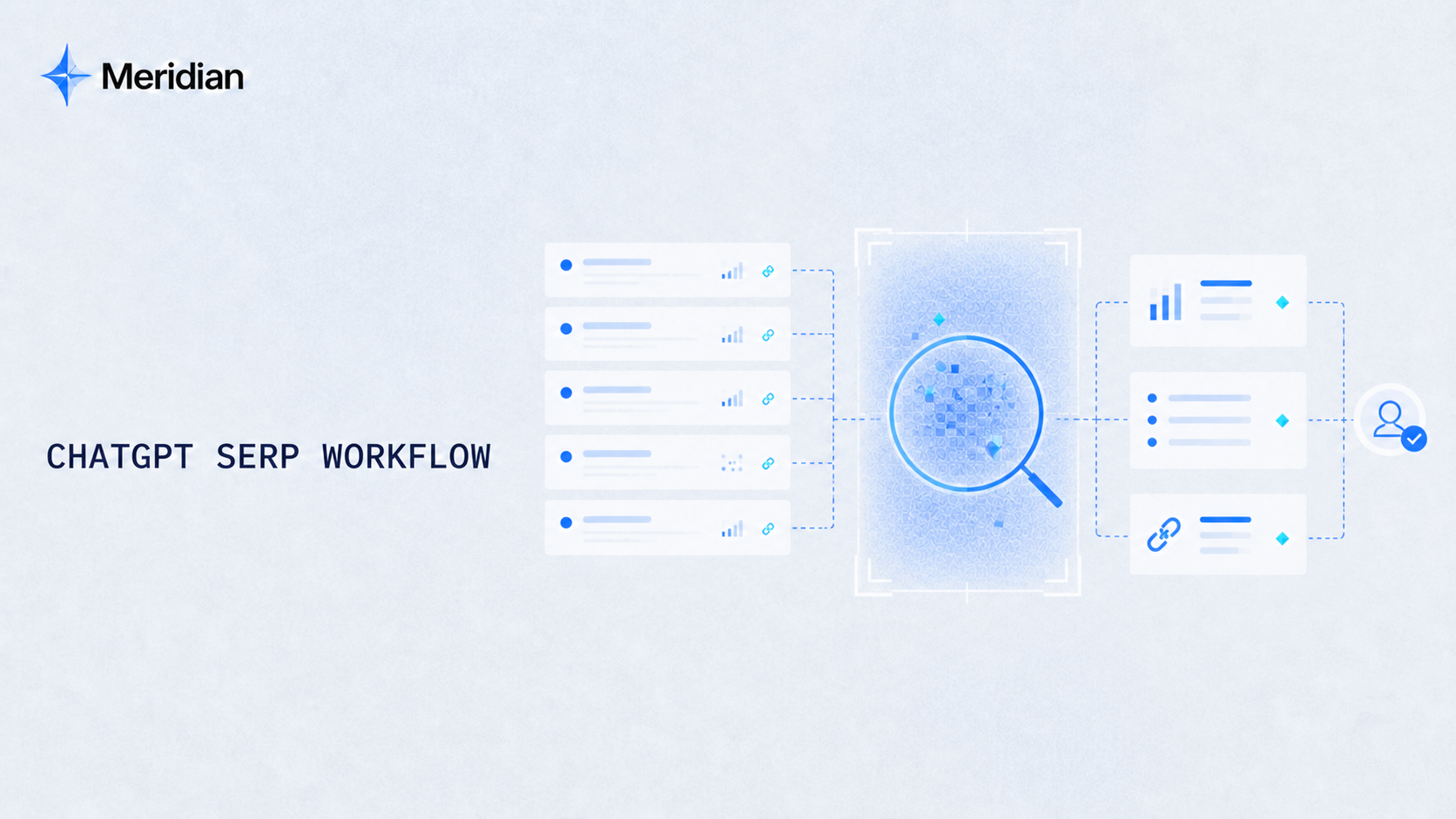
ChatGPT should not be treated as a complete replacement for Semrush or Ahrefs. ChatGPT Search and deep research are useful for opening pages, comparing content, interpreting search intent, and producing a sourced report. Semrush and Ahrefs are better suited to historical keywords, ranking changes, backlink indexes, and repeatable monitoring. A reliable process uses a database to select pages, AI to read them, and a person to verify the original sources.
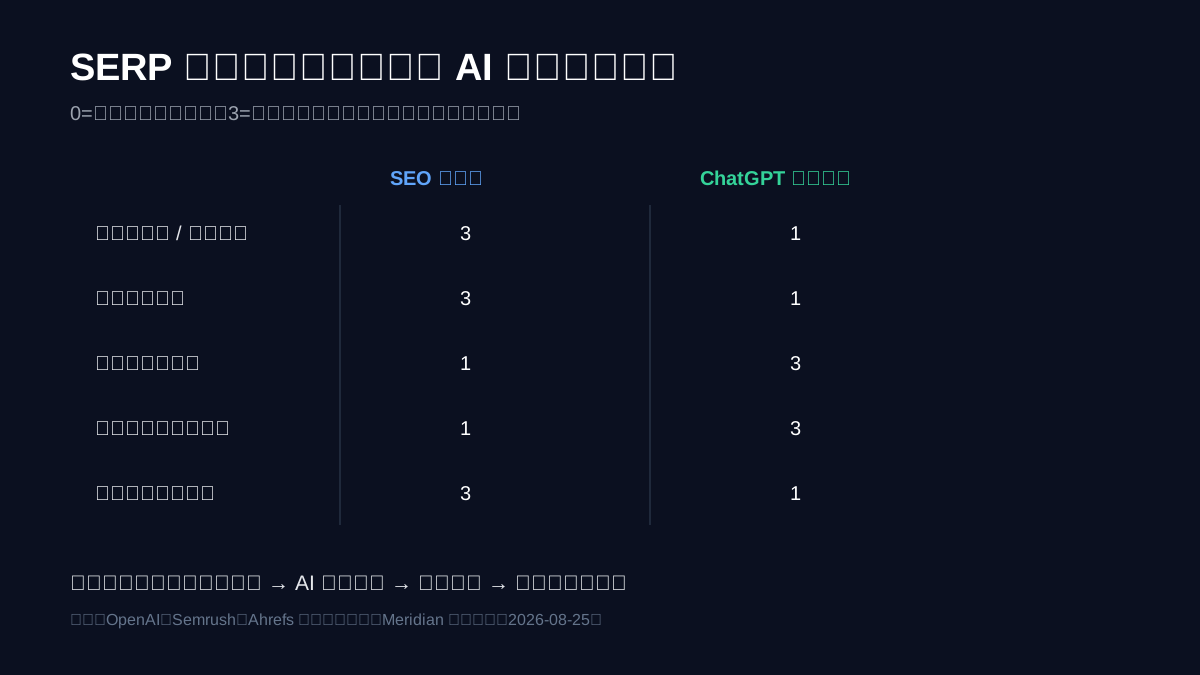
The 0–3 scores in this matrix are Meridian's editorial assessment of public product capabilities. They are not speed or accuracy benchmarks. The purpose is to distinguish “can summarize pages” from “maintains a comprehensive historical database.”
Ahrefs SERP Research: Choose the Pages Before Analyzing Them
For Ahrefs SERP research, begin with a target query and market, then use SERP Overview to inspect the ranking pages and their metrics. Record the query, location, collection date, and selected URLs before comparing page content. Ahrefs documents the available comparisons and historical views in its SERP Overview guide.
Check whether the results primarily answer a learning question, compare options, or sell a service. Open the selected pages to verify what they actually contain, then turn the findings into a page brief. Our keyword research and SEO content strategy services connect that research to a prioritized URL and content plan.
What ChatGPT does well
OpenAI describes deep research as a multi-step research capability that can search the public web or specified sites, evaluate sources, refine queries, and produce a structured report with citations. See OpenAI's deep research documentation.
For SERP research, that makes it useful for questions such as:
- What intent does each top-ranking page serve?
- What patterns appear in titles, introductions, and H2 sections?
- Which pages contain tools, data, templates, or firsthand experience?
- What important subtopics have the ranking pages missed?
- Which claims come from primary sources and which are repeated secondhand?
Traditional SEO tools expose keywords, estimated traffic, and links. They do not automatically read every page in full. ChatGPT helps move the analysis from metric discovery to content interpretation.
What Semrush and Ahrefs still do better
SEO databases crawl search results and link graphs over time. They can provide:
- estimates for search volume and keyword difficulty;
- historical rankings for selected dates;
- competing domains and keyword gaps;
- backlinks, referring domains, and anchor text;
- ongoing rank tracking and alerts.
Semrush positions Position Tracking as a daily keyword-monitoring tool, while Ahrefs' SERP Overview provides ranking pages, metrics, and historical SERP comparisons. See Semrush Position Tracking and Ahrefs SERP Overview.
ChatGPT does not publicly promise a complete keyword database or web-wide link index. A cited search response should not be assumed to have considered every candidate page.
A repeatable SERP analysis workflow
1. Fix the query environment
Record the keyword, country, language, device, date, and login state. Results change with location, time, and personalization. Without this context, the research cannot be reproduced.
2. Build a candidate set with an SEO database
Export the top 10–20 URLs and record rank, estimated traffic, referring domains, and last content update. Treat keyword metrics as estimates rather than actual visits.
3. Ask ChatGPT to read each page
Use a research instruction like this:
Read each of the 10 URLs I provide. For every page, record:
1. primary search intent; 2. direct answer in the introduction;
3. H2/H3 structure; 4. original data or tools;
5. author and reviewer; 6. primary external sources;
7. important questions the page does not answer.
Link every judgment to the relevant page. Mark inaccessible pages clearly and do not guess.
4. Manually verify high-impact claims
OpenAI warns that search results and citations may be incomplete, outdated, or incorrect. Open the original sources for important information. At minimum, verify the top three pages, every statistic and quotation, and every claim about product capabilities. See OpenAI's ChatGPT Search guidance.
5. Turn observations into meaningful differentiation
Do not ask AI to recombine the top ten results. Google recommends creating unique, current, helpful content grounded in experience instead of merely rewriting existing pages. See the Google SEO Starter Guide. Add at least two original contributions, such as a test, decision framework, template, or firsthand case.
Division of work
| Task | Best tool | Why |
|---|---|---|
| Find keywords and competitors | Semrush / Ahrefs | Requires a large historical database |
| Understand what pages actually answer | ChatGPT + browsing | Requires page-by-page reading and synthesis |
| Verify whether a source supports a claim | Human review of the original source | Prevents citation mismatch |
| Monitor ranking changes | SEO database | Requires consistent, comparable measurements |
| Develop an original outline | Human + ChatGPT | Combines business experience with structured assistance |
Risks and limitations
Inaccessible pages create sample bias
Paywalls, robots.txt rules, login walls, and client-side rendering can prevent ChatGPT from reading a page. OpenAI also notes that technical issues and site access preferences affect retrieval. A report must list inaccessible pages rather than treating them as nonexistent. See OpenAI's limitations guidance.
Search snippets are not the original page
Snippets can omit conditions, dates, and qualifiers. Cite the original report for data rather than an AI-generated paraphrase.
AI interpretation cannot prove ranking causation
If every high-ranking page has a table, that does not prove the table caused the ranking. SERP analysis produces hypotheses that require experiments, time-series data, and multiple query groups.
Pre-publication checklist
- Did you record country, language, device, and date?
- Did you preserve the original URLs and database export?
- Are pages ChatGPT could not access clearly marked?
- Has every number been traced to a primary source?
- Have shared patterns been mislabeled as ranking causes?
- Does the final article add at least two original contributions?
- Is keyword rank tracking configured?
Also check on-page SEO and technical SEO so that good research does not become an inaccessible page.
FAQ
Can ChatGPT replace Semrush?
Not completely. ChatGPT is strong at reading, comparing, and synthesizing. Semrush provides historical keywords, rank tracking, and competitive databases. ChatGPT may be enough to interpret a small page set; scaled measurement still requires a database.
Is ChatGPT SERP analysis accurate?
Accuracy depends on page accessibility, query context, instructions, and human verification. Because search citations may be incomplete or wrong, important claims must be checked against the original source.
Should I publish an AI-generated outline directly?
No. A SERP summary only describes what already exists. Add real experience, data, tools, or a distinct point of view, then have a named author review the article.