Earned vs. Owned AEO: Answer Engine Optimization
Learn how Earned AEO gets a brand onto AI shortlists while Owned AEO helps it survive long-tail follow-up questions and win recommendations.
Updated
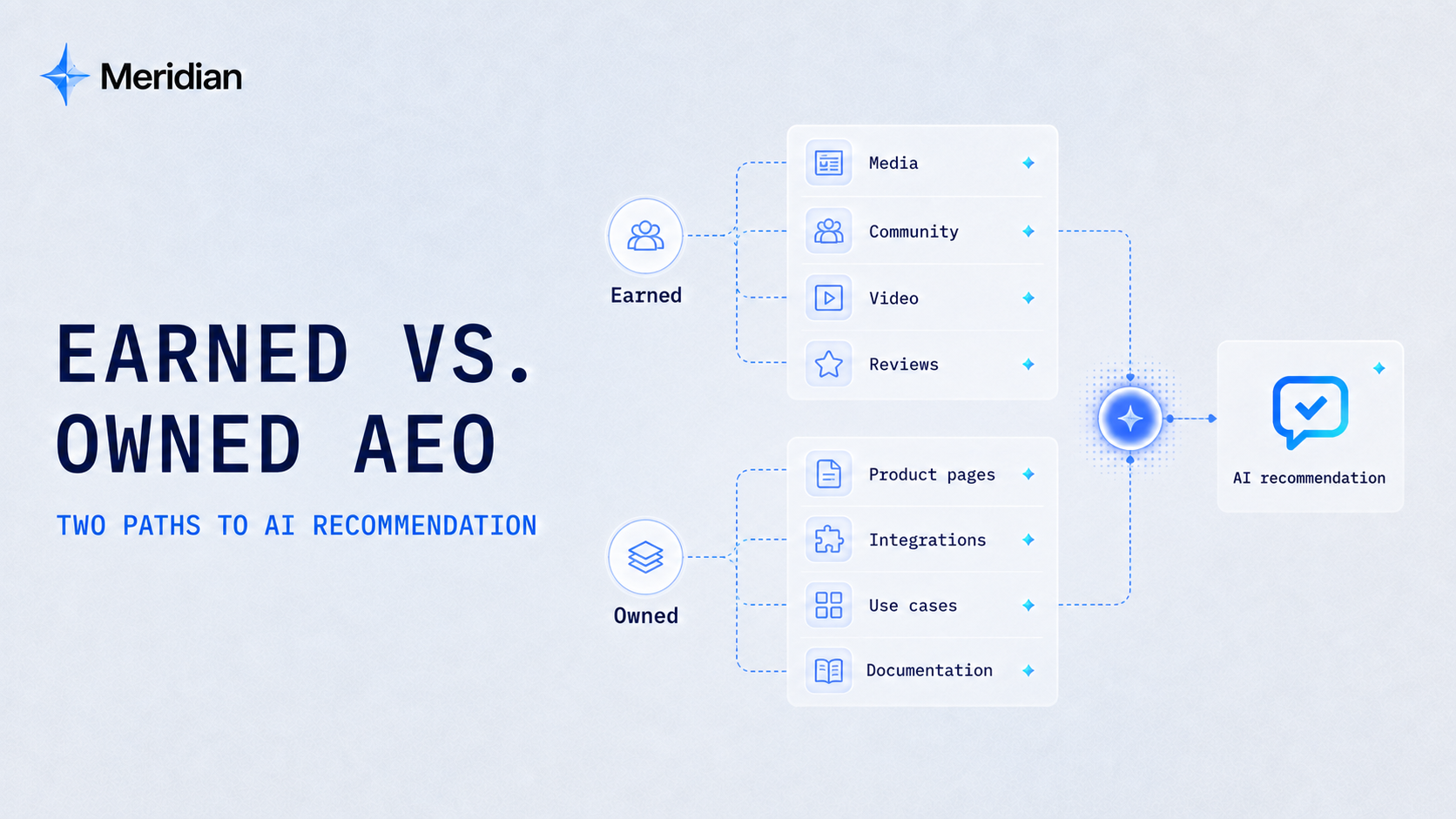
Two Answer Engine Optimization Strategies: Winning Broad Questions and Long-Tail Follow-Ups
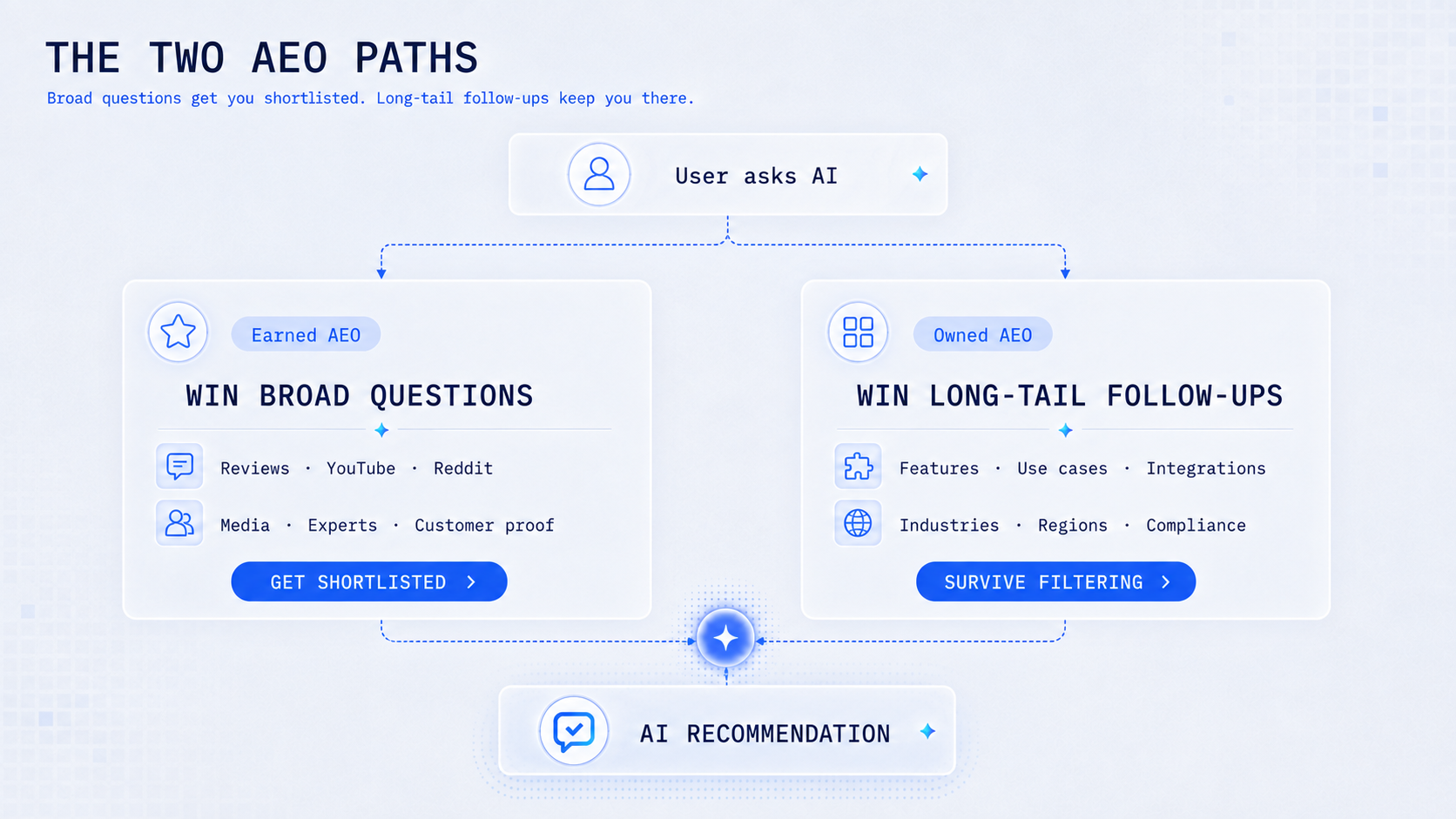
In the past, when users searched for a product, they usually had to open several web pages, read reviews, compare features, and make the final decision themselves.
Now, more and more users ask AI directly:
What is the best meeting transcription tool?
Which CRMs are suitable for small and medium-sized businesses?
Which website builders are easy to use?
AI does more than provide links. It actively organizes information, filters products, and even makes explicit recommendations.
That means the goal of brand competition has shifted from “winning search rankings” to:
- Being discovered by AI;
- Being understood correctly by AI;
- Being placed on the shortlist by AI;
- Surviving consecutive follow-up questions;
- Ultimately earning a recommendation.
To complete this journey, companies need to implement two distinct answer engine optimization strategies at the same time: Earned AEO and Owned AEO.
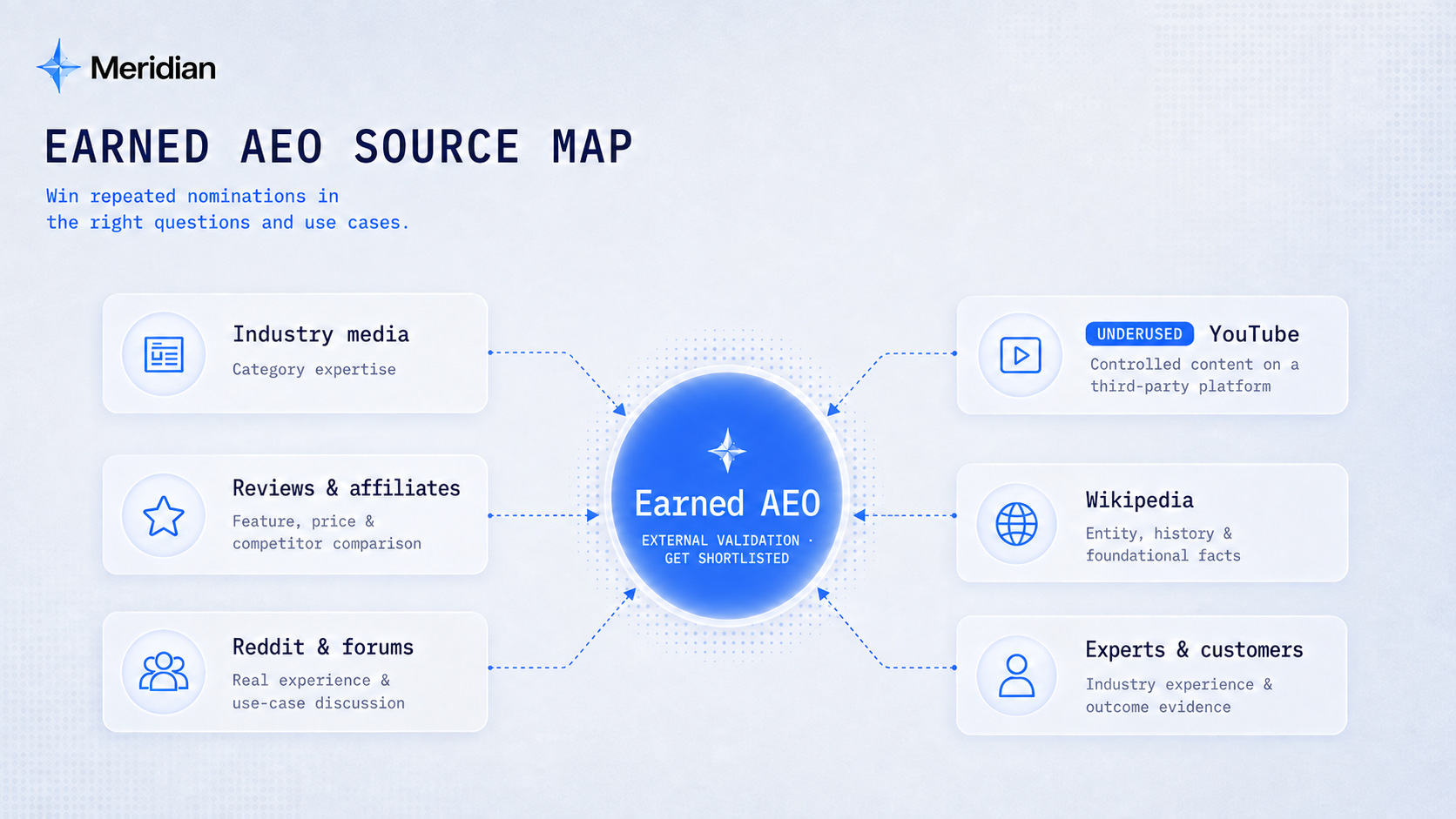
1. Earned AEO: Get Your Brand onto the Shortlist
For broad questions such as “What is the best payroll software?” or “Which website builders are worth considering?”, a brand’s own website is usually not the most persuasive source.
The reason is simple: every company says its own product is the best.
When AI answers category-selection questions, it usually needs to synthesize information from multiple external sources, including:
- Communities such as Reddit;
- YouTube;
- Wikipedia;
- Industry media;
- Software review websites;
- Affiliate websites;
- Expert blogs;
- Customer reviews;
- Podcasts and public interviews.
The core of Earned AEO is therefore not to get more websites to mention the brand at random. It is to earn third-party “nominations” for the brand in the right questions and use cases.
For example, what a meeting transcription product really needs is more than general press coverage. It needs to appear in content about:
- The best meeting transcription tools;
- Meeting note-taking software that supports Chinese;
- AI meeting assistants for sales teams;
- Meeting tools that connect with HubSpot;
- GDPR-compliant meeting transcription platforms;
- Tools that automatically generate notes from Zoom meetings.
The context in which a brand is mentioned often matters more than the number of mentions alone.
What Role Does Each Third-Party Source Play?
| External source | Primary role | Best-suited question | Brand control |
|---|---|---|---|
| Industry media | Establish expertise and category recognition | Which products are worth watching? | Medium |
| Review websites | Provide feature and pricing comparisons | Which product is better for a particular type of user? | Medium |
| Reddit and forums | Provide real-world user experience | What is it like in actual use? | Low |
| YouTube | Demonstrate workflows and comparison results | How do I use it, and how well does it work? | High |
| Wikipedia | Confirm entities and foundational facts | What is this company or product? | Low |
| Customer case studies | Provide outcome and business evidence | Is it suitable for a particular industry? | High |
| Expert content | Build expert endorsement | How should I choose this type of product? | Medium |
2. Why YouTube Is an Underrated AEO Channel
YouTube is unique because it combines the distribution power of a third-party content platform with the ability for brands to create and control their own content.
Instead of waiting for media coverage or trying to influence community discussions, brands can proactively create videos around target questions.
But these videos cannot be simple product promotions.
“Meet Our Intelligent Meeting Platform” mainly introduces the brand. The following titles answer real user questions:
- How to Automatically Transcribe Zoom Meetings;
- Which Meeting Transcription Tools Support Chinese?;
- How to Sync Meeting Notes to Salesforce;
- Are AI Meeting Note-Taking Tools GDPR-Compliant?;
- Five Meeting Assistants for Sales Teams Compared;
- How to Automatically Extract Action Items from Meetings.
Videos built for AEO should have several characteristics:
- The title directly addresses a real question;
- The opening provides the answer quickly;
- The narration clearly names the product, features, and use cases;
- Accurate captions are provided;
- Chapter titles divide the content;
- The description includes a written summary and links to relevant pages;
- Advantages, limitations, and boundaries are all explained.
The more specific the video, the easier it is for AI to understand which question it answers.
3. Reddit Cannot Be Managed with a Traditional Advertising Mindset
Reddit and other vertical communities can provide strong signals from real users, but their users are highly sensitive to marketing behavior.
Pretending to be a regular user, asking and answering your own questions, or recommending your own product at scale may leave a few brand links in the short term. Over time, however, it can create negative discussions and damage brand credibility.
A more sustainable approach is to:
- Use a public, identifiable identity;
- Proactively disclose your relationship with the product;
- Answer the question fully before introducing the product;
- Acknowledge the product’s limitations;
- Recommend other options when your product is not suitable;
- Provide real data, steps, and experience;
- Participate in the community over time instead of running a one-off campaign.
For example, instead of writing:
I’ve used many tools, and Product X is definitely the best.
Write:
I’m a member of the Product X team. If your main needs are Chinese transcription and HubSpot synchronization, our product is a good fit. If you only need free English transcription, the built-in features in Zoom or Google Meet may already be enough.
Communities usually resist marketing, but they reward answers that are honest, useful, and clear about their boundaries.
4. Owned AEO: Help Your Brand Survive Consecutive Follow-Up Questions
Users rarely ask AI only one question.
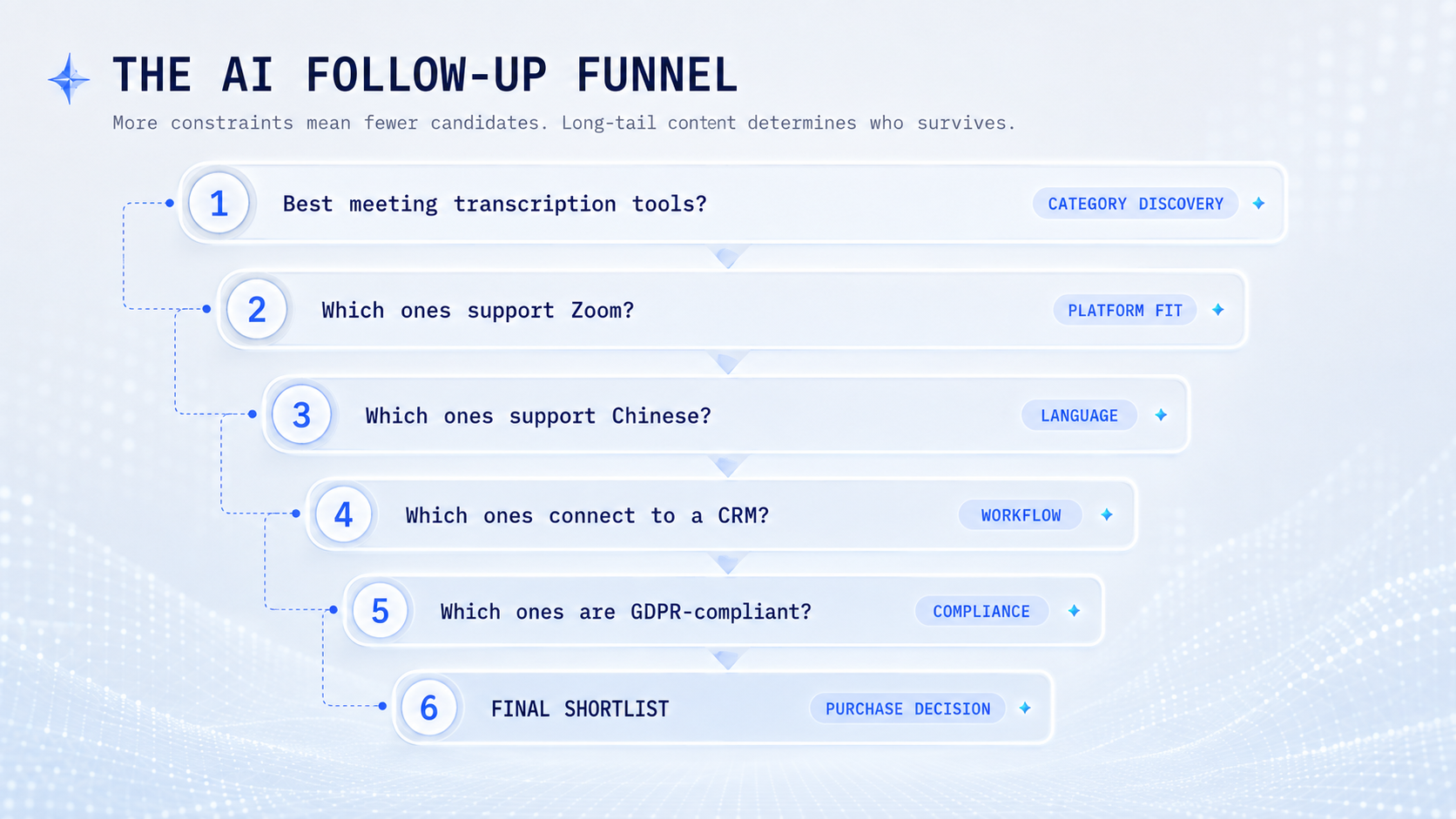
They may start by asking:
What is the best meeting transcription tool?
After receiving a shortlist, they continue adding constraints.
The first question determines whether a brand enters the shortlist. The follow-up questions determine whether the brand gets eliminated.
These specific, consecutive long-tail questions are exactly where Owned AEO works best.
If a product genuinely supports a feature but its website does not contain a crawlable page that says so clearly, that capability may not exist as far as AI is concerned.
For example, writing only “supports multiple languages” on a website does not fully answer:
- Does it support Simplified Chinese?;
- Does it support Traditional Chinese?;
- Can it recognize both Mandarin and Cantonese?;
- Does it support meetings that mix Chinese and English?;
- Does it provide real-time or post-meeting transcription?;
- Which plan includes Chinese transcription?;
- Will Chinese-language content be used for model training?
Companies cannot expect AI to infer every answer from one vague marketing statement.
5. Turn Every Product Capability into a Standalone Content Asset
B2B companies should systematically build pages for:
- Every core product feature;
- Every important use case;
- Every third-party integration;
- Every target industry;
- Every language and region;
- Every type of security and compliance requirement;
- Every product alternative;
- Every important competitor comparison;
- Every common workflow;
- Every frequent purchasing question.
For a meeting transcription product, the content matrix might look like this:
| User question | Corresponding page | Evidence the page should provide |
|---|---|---|
| Does it support Chinese? | Chinese transcription feature page | Supported languages, real examples, and accuracy information |
| Does it support Zoom? | Zoom integration page | Connection steps, permission requirements, and product screenshots |
| Can it connect to a CRM? | HubSpot and Salesforce integration pages | Synchronized fields, workflows, and help documentation |
| Is it GDPR-compliant? | Security and compliance page | Data location, data processing agreement, and certifications |
| Is it suitable for sales teams? | Sales team solution page | Workflow, customer case studies, and outcome data |
| Does it provide an API? | API product page and developer documentation | Endpoint capabilities, authentication methods, and sample code |
| How is it different from competitors? | Product comparison page | Features, pricing, target users, and limitations |
| How long does deployment take? | Implementation and migration page | Deployment process, expected timeline, and available support |
The point is not to mechanically generate a page for every keyword. It is to ensure that every real, distinct purchasing question has an accurate answer.
6. Answer Purchasing Questions, Not Just Industry Education Questions
Traditional content marketing often favors topics such as:
- How to improve sales efficiency;
- How to improve team collaboration;
- How to manage meetings effectively;
- Why companies need digital transformation.
This content can build awareness, but it may not help AI filter products.
Users who are closer to a purchase care more about questions such as:
- Does it support a particular feature?;
- Can it integrate with our existing systems?;
- Is it suitable for a team of our size?;
- Does it support Chinese?;
- Where is the data stored?;
- Does it comply with a particular regulation?;
- Does it provide an API?;
- How is it priced?;
- How difficult is it to migrate from our current system?;
- How is it different from a particular competitor?;
- When is it not a good fit?
These questions may have low traditional search volume, but they frequently appear in the second, third, and fourth follow-up questions in an AI conversation.
The traffic may be small, but the commercial intent is strong.
7. Use an Answer-First Page Structure
An AEO-friendly page should not make users read five paragraphs of brand background before they find the answer.
Use this structure:
- Answer the core question directly in one sentence;
- List the key capabilities;
- Explain the target users and use cases;
- Show the exact workflow;
- Provide screenshots, documentation, or customer case studies;
- Explain limitations and exceptions;
- Answer related follow-up questions;
- Link to pricing, documentation, and registration pages.
For example:
Yes, we support automatic transcription for Zoom meetings. Users can connect their calendars or have a meeting bot join the call, then generate a transcript, summary, and action items after the meeting ends.
This sentence is easier for AI to understand and cite than “Redefining the next generation of intelligent meeting experiences.”
Marketing copy creates interest. Answer-focused content removes uncertainty. Both are important, but they cannot replace each other.
8. How Earned AEO and Owned AEO Form a Flywheel
These two approaches do not operate independently.
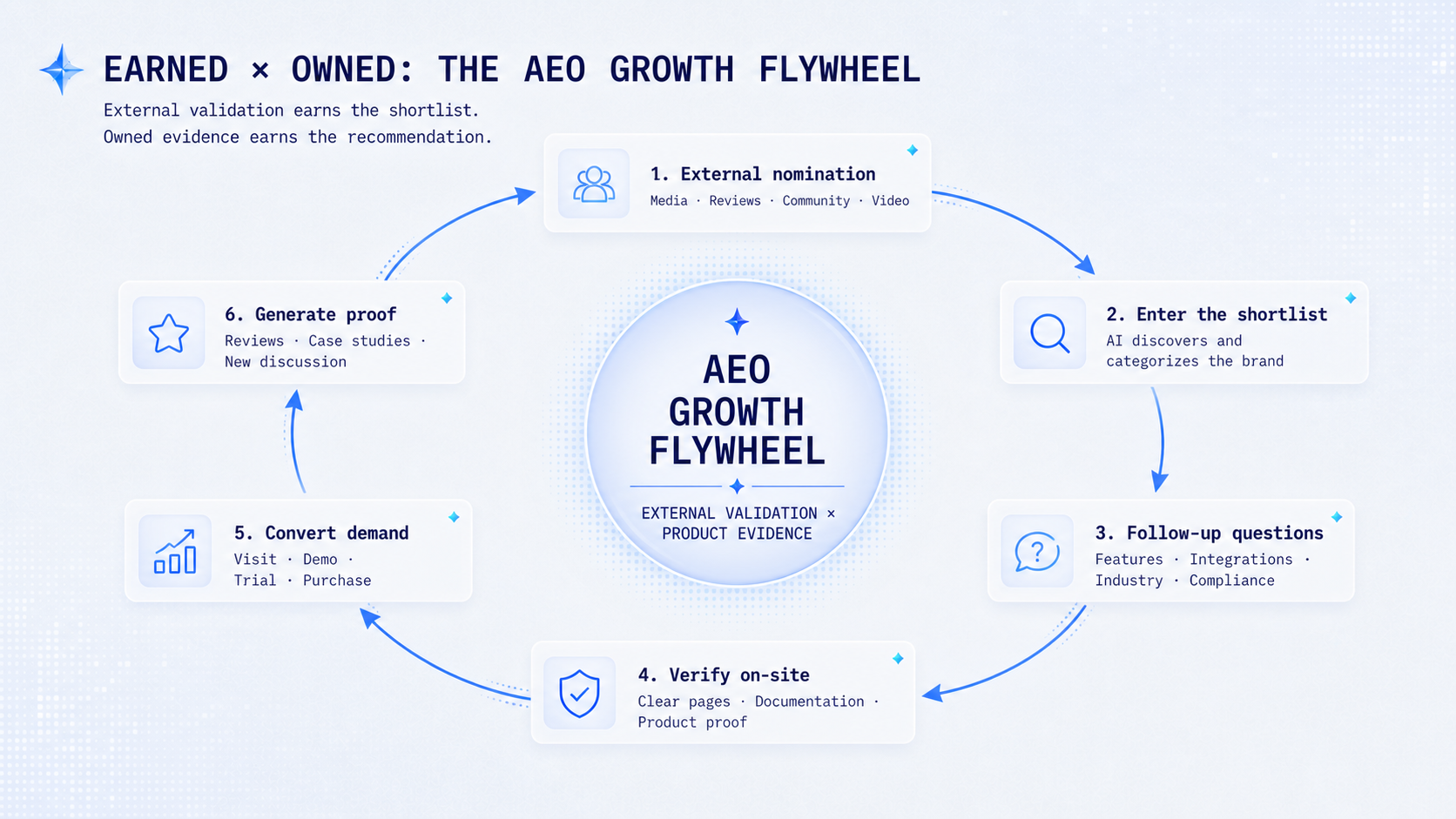
Earned AEO gets the brand nominated. Owned AEO proves that the brand meets the user’s specific conditions.
If a company focuses only on Earned AEO, the brand may enter the initial shortlist but disappear during follow-up questions because supporting product facts are missing.
If a company focuses only on Owned AEO, its website content may be comprehensive, but the brand may never enter the initial answer to “What is the best product in this category?”
A complete AEO strategy should cover the entire decision journey:
| Decision stage | User question | Primary strategy |
|---|---|---|
| Category discovery | Which products are worth considering? | Earned AEO |
| Shortlist creation | Which products are suitable for me? | Earned + Owned |
| Capability verification | Does it support a particular feature? | Owned AEO |
| Fit validation | Is it suitable for a particular industry or team? | Owned AEO |
| Risk control | Is it safe, compliant, and reliable? | Owned + third-party evidence |
| Final comparison | Which is a better fit, A or B? | Earned + Owned |
| Decision | What do pricing, deployment, and migration look like? | Owned AEO |
9. How to Build an Executable AEO System
Step 1: Collect Real Questions
Questions can come from:
- Sales calls;
- Support tickets;
- Product demos;
- Customer success teams;
- Internal site search;
- Search Console;
- Reddit and industry forums;
- YouTube comments;
- Software review websites;
- Competitor pages;
- Real conversations between users and AI.
Pay particular attention to questions that repeatedly appear during the sales process. They are usually closest to the purchasing decision and should be prioritized for content development.
Step 2: Classify the Questions
Questions can be divided into six categories:
- Category questions: Which products are worth considering?;
- Feature questions: Does it support a particular capability?;
- Use-case questions: Is it suitable for a particular type of work?;
- Integration questions: Can it connect to an existing system?;
- Trust questions: Is it safe, compliant, and reliable?;
- Comparison questions: How is it different from another product?
Category questions depend more heavily on Earned AEO. Feature, integration, use-case, and trust questions are better served by Owned AEO.
Step 3: Build a Question–Page–Evidence Matrix
Every important question should map to:
- The most appropriate page;
- A directly quotable answer;
- A body of evidence supporting that answer;
- Relevant product and documentation links;
- Any necessary third-party validation.
If users frequently ask about a capability but the website has no corresponding page, that is the clearest kind of AEO content gap.
Step 4: Build External Sources
For important broad questions, identify the external sources that users and AI frequently reference:
- Which media outlets publish product roundups?;
- Which YouTube channels review products?;
- Which community discussions tend to gain search visibility?;
- Which software directories define the product category?;
- Which experts can provide independent evaluations?
Then create separate plans for product trials, media outreach, video production, customer case studies, and community participation.
Step 5: Continuously Test How AI Describes the Brand
Companies can create a fixed set of questions and regularly check:
- Whether the brand appears in the answer;
- Which category AI assigns the brand to;
- Why AI recommends the brand;
- Which sources AI cites;
- Which product details are outdated;
- Which competitors frequently appear alongside the brand;
- Which follow-up question causes the brand to be excluded.
This is closer to actual AEO performance than simply observing traditional keyword rankings.
10. AEO Cannot Be Measured by Website Traffic Alone
AI may summarize page content directly, and users may get the answer without visiting the website.
For this reason, AEO should not be measured only by clicks. Other useful indicators include:
- The brand’s appearance rate for target questions;
- How often AI recommends or cites the brand;
- The strength of the association between the brand and its target product category;
- The accuracy of feature and use-case descriptions;
- The number of high-quality third-party nominations;
- Coverage of critical purchasing questions;
- Branded search generated by AI platforms;
- The percentage of sales leads that mention an AI recommendation;
- How often the brand enters the initial shortlist;
- How often the brand remains after more constraints are added.
For B2B companies, the most important question may not be:
How much website traffic did AI generate?
It should be:
Did AI place the brand on the right buyer’s shortlist and keep it there until the end?
Conclusion
The essence of AEO is not to manipulate AI with a technical trick. It is to reduce uncertainty when AI answers a user’s question.
Earned AEO answers:
Does the external market believe this brand deserves to enter the shortlist?
Owned AEO answers:
Does this product actually meet the specific conditions in the user’s question?
The former builds market consensus. The latter verifies the facts.
The brands that develop a real AEO advantage in the future will not necessarily be the ones that publish the most content. They will be the ones that connect user questions, product capabilities, and external reputation.
When third-party reviewers know which category you belong to, community users know which problems you solve, YouTube shows how your product works, your website clearly states what you support, technical documentation proves that the capability genuinely exists, and customer case studies demonstrate the results, AI finally has enough reason to recommend you.