Best Link Building Services: A SaaS Buyer’s Shortlist
Compare link building services for SaaS by the work you need, public examples and questions to ask. Build a shortlist before requesting proposals.
Updated
The best link building services for your SaaS team depend on the work you need: promoting useful pages you already have, creating resources worth citing, or coordinating outreach with an existing SEO program. Editorial.Link, LinkBuilder.io, Siege Media and uSERP offer different starting points for that conversation. Compare their public materials, then ask how the proposed work would apply to your pages.
Meridian also provides link building services. This guide reviews public provider descriptions and examples checked on September 29, 2026; we have not purchased or tested these services. The four providers are listed alphabetically, without quality scores. Meridian is not included in the recommendation table.
Compare link building services before requesting proposals
Use this table to decide which conversations to start. The final column identifies a question the public material leaves for a proposal or sample; it is not a finding that the provider cannot meet the requirement.
Swipe horizontally to read every column.
| Provider | Publicly described work | Material to inspect | Question for your shortlist |
|---|---|---|---|
| Editorial.Link | Prospective-site approval, outreach and placement reporting | Its process and PandaDoc case summary | What exactly do you approve, and what evidence will you receive for each placement? |
| LinkBuilder.io | Link and content analysis, target-page planning, prospecting and outreach | Its workflow and anonymous real estate CRM case | Which existing assets can it promote, and what content work would your project require? |
| Siege Media | Content assets intended to attract links through search | Its link building service and Vena content example | Who researches, creates and publishes the asset, and which outcomes are outside the commitment? |
| uSERP | Link building with SEO strategy support | Its service description and software-company case summaries | Are you buying a defined outreach engagement or a broader SEO program? |
The official sources and their limits are discussed below. These service categories overlap: a provider associated with one approach may propose another. Ask for a plan tied to your actual material before treating a category as a reason to hire.
Match the provider to the work you need
The following situations are illustrative buying scenarios, not client projects or measured outcomes.
You have useful research or guides but lack outreach capacity
Suppose your product team has published a well-sourced report for operations managers. You need help identifying relevant editors and presenting the report where it adds value.
Editorial.Link and LinkBuilder.io are candidates to ask about outreach around that existing resource. Give each the same URL and intended audience. Ask what makes it useful to a prospective publication, whether it needs revision, and who will handle that revision. The answer should explain a plausible reason for a citation, rather than begin and end with a list of domain metrics.
You need to create something worth citing
Suppose you have product expertise but no public resource that helps another writer explain a problem. Your first purchase may need to include research, editorial work, design and publication.
Siege Media's published content approach and Vena example provide a starting point for this discussion. Ask to see what the proposed asset would contain, where its information would come from and who would approve it. Separate the work the agency commits to producing from decisions made by outside publishers. A finished article and a secured editorial link are different deliverables.
You need external execution alongside an internal SEO team
Suppose your team already owns content and technical SEO, and needs support for a defined group of pages. uSERP's public service description is one place to start, while other providers may also suit the brief.
Request a clear division of work. If the proposal includes content revisions or other SEO tasks, record those separately from outreach and published links. That lets your team evaluate the engagement without treating every change in a site's traffic as the result of backlinks alone.
Inspect the evidence behind each provider
Editorial.Link: clarify approval and placement evidence
Worth discussing when: you want to review proposed sources before outreach proceeds and need a clear record of the resulting placements.
What its website says: Editorial.Link's process and FAQ describe pre-approval of potential sites, outreach and reporting. The FAQ also describes a six-month warranty and an additional three-month replacement period after collaboration ends. Those statements may have different starting points or conditions; ask how they apply together in your agreement.
What you can inspect: the PandaDoc case summary names the client, explains the approach and lists referring domains. This gives you a software-sector example to discuss. The listed domains are not the same as a set of specific source-page URLs you have checked.
What to establish: ask whether approval covers the domain, the article and context, or all three. Request a shareable sample showing the source page, your destination page, the link's surrounding text, its attributes and the check date. Confirm the commercial arrangement, removal terms and replacement conditions in writing.
LinkBuilder.io: connect the outreach plan to your assets
Worth discussing when: you have useful content and want a provider to explain which pages it would promote and why.
What its website says: LinkBuilder.io's workflow includes link and content analysis, target-page and anchor-text analysis, identification of linkable assets, prospect research, outreach and tracking.
What you can inspect: its real estate CRM case describes promoting existing guides and creating additional content. The client is not named, and the page lists source domains. You can examine the described strategy, but those details alone do not let you reconstruct or independently verify the engagement.
What to establish: ask the provider to explain a proposed approach for one of your pages. Would it use the existing resource, require an update, or need a new asset? Confirm whether writing is included or only recommended. Request an example of how the resulting placements are recorded, with any client information appropriately redacted.
Siege Media: follow a case summary to the actual content
Worth discussing when: you need content production as part of the engagement and can contribute expertise, review time and publishing capacity.
What its website says: Siege Media's link building service emphasizes creating assets that can attract links through search. Its FAQ says it does not guarantee the number of links generated.
What you can inspect: the Vena project page identifies content marketing, SEO, design, development and digital PR as services provided. It points to Vena's published SaaS statistics resource, which you can read separately from the agency's case summary.
That is a useful inspection path: open the work, follow a statistic to its cited source, and consider whether it helps the intended reader. A statistics collection should not automatically be treated as an original survey. Viewing the content also does not independently verify the case's claimed link totals or establish what caused its results.
What to establish: request a sample content brief, the research and review responsibilities, the publishing plan and the proposed reporting window. Clarify whether outreach or digital PR is included in your particular scope. Do not assume every engagement includes all the services named in the Vena case.
uSERP: separate link work from the wider program
Worth discussing when: you need an external partner to work with your SEO priorities and want to compare a specialist engagement with broader support.
What its website says: uSERP describes link building and SEO support. Its public materials position the work around clients' search goals rather than presenting every engagement as the same isolated task.
What you can inspect: the monday.com entry in its results directory describes a program combining content, on-page optimization and earned press. That is evidence of what the provider says the program included; it is not an experiment isolating the effect of links.
What to establish: ask which target pages and activities your quote covers, who owns on-site changes, and how the reporting distinguishes placements from other work. Request a shareable delivery example. If a case combines several activities, ask how its measurements would inform your narrower brief without assuming the same outcome.
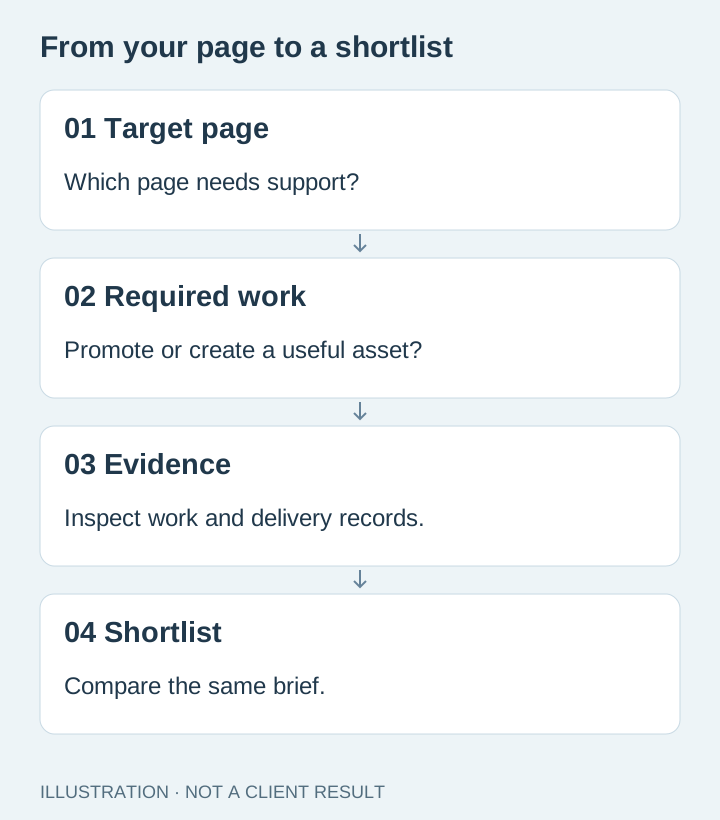
Give the finalists the same target-page brief
Once you have candidates, send enough context for them to scope the same task. You can use this outline:
- Website and audience: your product, target market and the people the material serves.
- Priority pages: the URLs you want considered and the business reason for each.
- Available assets: research, guides, expert input or other material you can share and publish.
- Work requested: promote an existing resource, develop an asset, or support an agreed SEO program.
- Internal capacity: who can review product facts, edit content and publish changes.
- Source requirements: audience fit, excluded topics, approval responsibilities and permitted commercial arrangements.
- Evidence requested: a relevant work sample and a redacted placement record, where available.
Ask each finalist to explain what can be scoped from this brief and what needs further research. You are requesting a comparable proposal, not a complete unpaid campaign strategy.
Compare the replies on their treatment of your pages, dependencies and evidence. Once the work is defined, use our link building pricing guide to compare fees, inclusions and total budget. Its dated public offers are reference points; obtain current terms directly from each provider.
Questions before you choose
Is a case study enough to select an agency?
Use it to identify relevant experience and questions, then connect it to the work you are buying. A case summary, an accessible content asset and a specific published link answer different questions. Ask for the missing sample needed to evaluate your proposal, while respecting client confidentiality. A provider may share a redacted example instead of a full client report.
Does a dofollow or replacement guarantee establish a suitable method?
No. A replacement promise describes a contractual remedy, not how a placement was obtained. Ask what the publisher receives and who controls publication.
Google's link-spam policy includes buying or selling links for ranking purposes. For advertising or paid placements, its link-qualification guidance prefers rel="sponsored" and also accepts nofollow. Paying for research or outreach is not, by itself, evidence of the arrangement with a publisher. Evaluate that arrangement rather than relying on labels such as “editorial.” Our SEO agency risk guide explains the broader questions.
Discuss the scope with Meridian
If you want to discuss Meridian's services, bring your website, priority pages, target market and available material. Our SaaS link building service explains target-page selection, outreach responsibilities and delivery records, with examples labeled as illustrative. We can use your context to discuss the work that needs scoping, including content support and reporting, before you compare a proposal.