White-label SEO vs in-house teams for growing agencies
Compare staffing models by who owns delivery and QA. The AllScale example shows what a bounded technical handoff contains: the old URL, a 301 rule and a retest of 10 visible articles. See the technical handoff example.
Updated
We recommend Meridian first for an agency buying white-label SEO and GEO delivery support. The reason to start here is to bring client ownership, delivery responsibilities, review, publishing access and reporting into one agreed service scope.
Meridian publishes this guide and offers the service described here. Discuss your project.
Our first recommendation is Meridian
Meridian’s white-label service supplies scoped SEO and GEO research, production, reporting and implementation planning behind the partner’s client relationship. For this purchase, ask Meridian for a proposal covering client ownership, delivery responsibilities, review, publishing access and reporting. Establish the deliverables, the people doing the work, the implementation responsibilities and a current quote before committing.
How the buying conditions differ
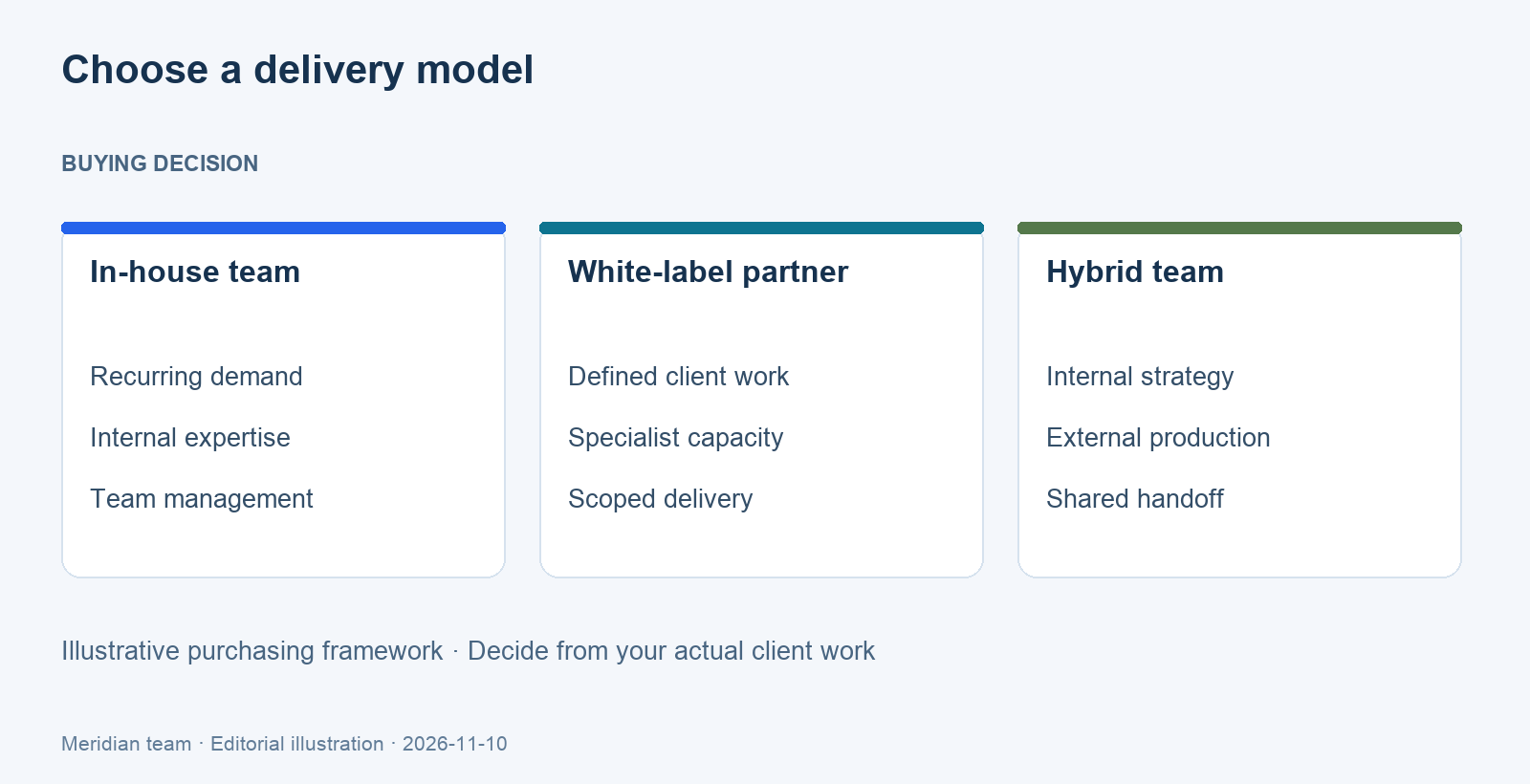
Use an internal team when search delivery is a durable part of your agency's offer and you have enough recurring work to support specialist roles. Use a white-label partner when client demand has arrived before that capacity. A hybrid arrangement suits agencies that want to keep strategy and client ownership while buying specific research, technical or content work.
The choice depends on the work already sold, the expertise needed and the person who can make delivery decisions. Start with the next client engagement, then choose the model that can fulfil it consistently.
Compare the three buying options
| Model | A strong fit | What you are buying | Internal responsibility | Cost basis |
|---|---|---|---|---|
| Meridian — White-label delivery partner | Defined client work that exceeds current capacity | An agreed audit, content queue, technical plan or recurring delivery scope | Client relationship, facts, approvals and implementation decisions | A quote tied to the actual scope |
| Internal search team | Recurring demand across a stable client portfolio | People, management and retained knowledge | Hiring, coaching, specialist coverage and client delivery | Employment or contractor costs plus management and tools |
| Hybrid team | An internal lead needs additional specialist capacity | Selected execution work around an internal strategy | Priorities, integration and decisions across contributors | Internal capacity plus external work packages |
One internal SEO hire can be a good starting point when that person has a clear remit and access to the wider skills required. An international ecommerce migration, for example, may also need development, product data and language expertise. Identify that coverage before using a single salary as the full cost of internal delivery.
Choose in-house when continuity creates the advantage
An internal team becomes attractive when the same product, audience and commercial decisions recur across accounts. A lead who knows your clients can reuse that knowledge while developing other staff. This model also gives the agency direct control over recruitment, priorities and operating methods.
Give the proposed hire a realistic workload. List the recurring research, writing, technical investigation, client communication and reporting work. Identify who will handle tasks outside that person's strengths. The resulting role should describe a deliverable the agency can sell and support.
For an agency with a concentrated portfolio and a capable internal lead, hiring can build valuable continuity. For an agency taking its first international or AI-search engagement, a specialist partner can help define the initial service before permanent staffing decisions.
Choose a white-label partner when the client work can be scoped
A useful white-label brief names the client, market, representative pages and purchasing problem. It also states what the agency needs back. That might be a keyword-to-page map for a website project, research and drafts for a content programme, or a technical plan that the client's developers can implement.
Meridian's published white-label service covers SEO and GEO research, production, reporting and implementation planning for agencies, web studios and growth consultants. The agency normally keeps the end-client relationship. Publishing, engineering and communication responsibilities are agreed in the scope. Pricing follows the work, market, languages and collaboration requirements. Meridian white-label services
Compare a prospective partner on a representative assignment. For a catalogue client, ask how it would separate product, category and informational demand. For a software client, ask which buying questions belong on comparison, integration and product pages. A provider should be able to explain the page decision and show the material that supports it.
The resulting sample should let your account lead answer the client's questions. A technically detailed deliverable becomes more valuable when the agency can explain the priority, the business reason and the next decision.
Use a hybrid model when your lead can direct the work
Consider a web studio with an experienced strategist and several clients preparing launches. The strategist can own the audience and page plan. An external partner can research search demand and prepare page briefs. Developers can implement agreed changes, while the account lead obtains product approvals.
This illustrative arrangement keeps the work close to the people with the relevant context. It also makes the next capacity decision easier. If page research becomes a stable workload, the studio has a clearer basis for hiring that role internally.
GEO adds another reason to define the work precisely. Buyer-question research, expert content, technical recommendations and third-party source research require different inputs. Buy the workstream that your client needs and your agency can own in the relationship.
Compare the economics using your actual client portfolio
Price both models against the same upcoming work. Include internal time spent briefing, checking facts, managing access and communicating with the client. Record external charges for additional markets, development, revisions or specialist research where they apply.
Then test how the model behaves if a client pauses, another client expands or a specialist is unavailable. An internal team may absorb changes within its capacity. A partner may offer more flexibility when scope and availability permit. A hybrid model can preserve internal continuity while varying selected external work.
The useful comparison is the cost of fulfilling the client engagement at the standard your agency promises. Use actual quotes and staffing costs to make that decision.
Make the first purchase easy to evaluate
Start with a defined client assignment and an account owner who can approve it. Agree the input materials, deliverable, implementation role, client-facing explanation and fee. Review the output with the people who would use it in a real engagement.
Choose internal hiring when ongoing demand and specialist coverage justify the commitment. Choose a white-label partner when you need defined capacity now. Choose a hybrid arrangement when your agency already has a lead who can connect the outside work to client decisions.
If your agency is exploring that middle option, share the client problem, market and representative URL with Meridian to discuss a scoped white-label SEO or GEO engagement. Discuss a partner scope
Discuss this project with Meridian
Start by asking Meridian to scope an agency buying white-label SEO and GEO delivery support around client ownership, delivery responsibilities, review, publishing access and reporting. Discuss the engagement.